Link exchanges are a risky link building tactic, because systematic swaps go against Google's guidelines. However, in our experience, they can also be very effective if you know how to approach them properly.
In this guide, we'll talk about what counts as a link exchange, what Google says about them, the main risks, and the steps our team follows to do them the right way.
Key takeaways
Direct link exchanges are riskier and, in our experience, less effective, because systematic swaps go against Google's guidelines. No respondent in a 500-person 2026 survey called exchanges their best tactic.
Google's spam policies list "excessive link exchanges" as link spam, and John Mueller has said relevance doesn't change that when you swap systematically.
Our team at Position Digital has earned at least 62 live links through link exchanges, with ranking listicles giving publishers a reason to say yes.
Three-way exchanges are safer and more effective than direct swaps in our experience, though no public test we've seen compares them.
What is a link exchange?
A link exchange is an agreement between two or more websites to link to each other, usually to earn backlinks without paying for them. You'll also see it called reciprocal linking or a link swap, and the deal can take several forms depending on who links to whom.
These are the main types of link exchange:
Type | How it works | Main risk |
|---|---|---|
Direct (reciprocal) swap | Site A links to Site B, and Site B links back | The loop is visible to anyone who checks both sites |
Three-way (ABC) exchange | Site B links to Site A, and Site A's owner links to Site B from a third site | You need a second site, and it's still a deal |
Guest post swap | Each site publishes an article from the other, with a link inside | Writing time, and a pattern if you repeat it |
Listicle swap | Each site adds the other to a "best X" article | A weak entry hurts the list's credibility |
Private influencer / network exchange (PIN / PBN-adjacent) | A closed group of site owners or creators trades links among its members | Coordinated links across a closed group can look like a private blog network |
Not every pair of links between two sites is a link exchange. Genuine partnerships create links because there's a real project to point to, and these are common examples of what doesn't count as a link exchange:
Co-hosted webinars or events. Two brands run a session together, and each links to the registration page or the recording.
Joint research. Two companies publish a study together, and each credits the other and links to the findings.
Independent citations. Each site cites the other's work on its merits, with no agreement to do so.
The difference is why the link exists. A partnership link would still be useful if search engines ignored it, while an exchange link is only there because of the deal. Calling a swap a partnership doesn't change that, so the rest of this guide focuses on deals.
Do link exchanges still work in 2026?
Direct link exchanges are riskier and, in our experience, less effective in 2026, because systematic swaps go against Google's guidelines and Google has gotten better at detecting these patterns. Some exchanges can still work at small scale, and a three-way exchange is the structure we'd pick when the link makes sense on its own.
Why direct swaps are the weakest option
Google's John Mueller said in 2021 that a you-link-to-me deal is "essentially against our webmaster guidelines." Google's December 2022 link spam update then said its SpamBrain system "can now detect" sites used to pass outgoing links.
A three-way exchange removes the direct loop between two sites, which is why we prefer it.
What the surveys show
Survey data mostly points the same way. Reporter Outreach's State of Link Building survey of 500 SEO professionals found that 43.8% use link exchanges, but none of them consider it their best link building tactic.
Editorial.link's backlink exchange guide is kinder: "9.3% consider link exchange to be an effective link-building tactic" in its survey of 518 respondents, ahead of niche edits at 4.6%. Both surveys come from companies that sell link building, so read them as direction.
What does Google say about link exchanges?
Google lists link exchanges as an example of link spam, which it defines as links created "primarily for the purpose of manipulating search rankings." The wording targets intent and excess, and Google hasn't published a number of swaps that counts as safe. Here's the line from its policy:
Excessive link exchanges ("Link to me and I'll link to you") or partner pages exclusively for the sake of cross-linking
That's from Google's spam policies. John Mueller went further in a July 2021 video, reported by Search Engine Roundtable. Asked whether topical relevance changes that, he said "It doesn't matter" if you're swapping systematically, and he called "I will do an exchange if you give me a link" something "we would consider unnatural."
What are the risks of link exchanges?
The main risks of link exchanges are wasted effort, ranking loss and an outbound link profile tied to every site you swapped with. Google says it tries to ignore unnatural links, so a link that does nothing is the first cost to plan for, even when no penalty follows.
These are the risks to weigh before you agree:
Links that pass no value. Mueller said Google's algorithms "try to ignore those links." Google's December 2022 link spam update post also says "any credit passed by these unnatural links are lost."
Manual actions and ranking loss. Google says automated systems and human review can catch violations, and that those sites "may rank lower in results or not appear in results at all."
An outbound footprint that outlasts the deal. Google said in 2022 that SpamBrain can detect "sites used for the purpose of passing outgoing links", so your side of the swap counts too.
Google's Search Status Dashboard lists four spam updates in 2026 as of November, and none is labeled a link spam update. That's no guarantee of safety, because the policy still stands.
When can a link exchange make sense?
A link exchange makes the most sense when each link would still be worth having without the deal, and when both sites share an audience. That doesn't make it compliant by Google's wording, so treat these formats as small, deliberate decisions and never as your link building plan.
Guest post swaps
A guest post swap means each site publishes an article from the other, with a link inside. Editors can judge each article on its merits, which gives the link a reason to exist beyond the trade.
Keep these occasional, because repeat swaps between the same sites start to look like the pattern Google describes. To land guest posts without a swap, follow our guest post outreach guide.
Listicle swaps
A listicle swap means each site adds the other to a relevant "best X" article. A listicle needs entries, so adding a relevant tool makes the list more useful to readers, and that gives the link a reason to exist beyond the trade.
This tactic can also improve your AI visibility. An Ahrefs study found that "best X" blog lists made up 43.8% of all page types among ChatGPT's source links across 750 prompts.
Our team's ChatGPT ranking factors study also found third-party listicle presence was the strongest correlate of recommendations (r = +0.64, 278 prompts). Neither study measures swaps, so list only tools that deserve the spot, or try listicle outreach with no trade attached.
Three-way exchanges
A three-way exchange, also called an ABC exchange, means Site B links to Site A, and Site A's owner links back to Site B from a third site. In our experience, three-way exchanges are safer and more effective than direct swaps, mainly because there's no direct A-to-B link loop.
How to vet a link exchange before you agree
Use the stand-alone link test: Would this link still be worth having, and worth giving, if the deal didn't exist? A no on that question ends the conversation, and the checks below cover the rest of the decision before any link goes live on either site.
These checks make up the stand-alone link test for a link exchange:
Reader value. Would you cite this page for your readers anyway?
Audience fit. Do both sites serve people who'd actually click the link?
Site quality. Set a bar for authority and traffic, and keep to it.
Placement. Is the link in the body of a real article? Google names "partner pages exclusively for the sake of cross-linking" as spam.
Outbound links. Check what else the site links to, because your link will sit beside those.
Share of your profile. Would exchanges become a visible share of your backlinks? Stay conservative, because Google publishes no safe number.
How to do link exchanges the right way
We've earned at least 62 live links through link exchanges for our own site and our clients, on sites with a median DR of 54. There are two ways to set up these deals: Publish listicles that attract inbound requests, or run outreach when your site doesn't have that visibility yet.
Publish listicles that rank in Google and get cited by AI
Listicles that rank high in Google and get cited by AI attract inbound link requests, because people want to be featured in them. Our own ranking listicles brought in those requests, and one campaign secured 18 listicle placements in seven months, as our listicle outreach case study shows.
Once an inbound request comes in, ask for a 2-to-1 exchange. A placement on a high-value listicle is worth more than one link, so ask for two in return or no deal: One from the site that asked, and one from its partner site.
We've even asked for 3 to 1 from sites with low DR and traffic.
Run outreach
If you have a new site with low visibility, getting high rankings and AI citations is hard, so you need to be proactive.
These are the steps to run link exchange outreach in ListBrew:
Create a campaign. Choose the campaign type that matches your offer, such as Listicles for a listicle exchange. Add your brand details, target keyword, location and the AI engines to check.
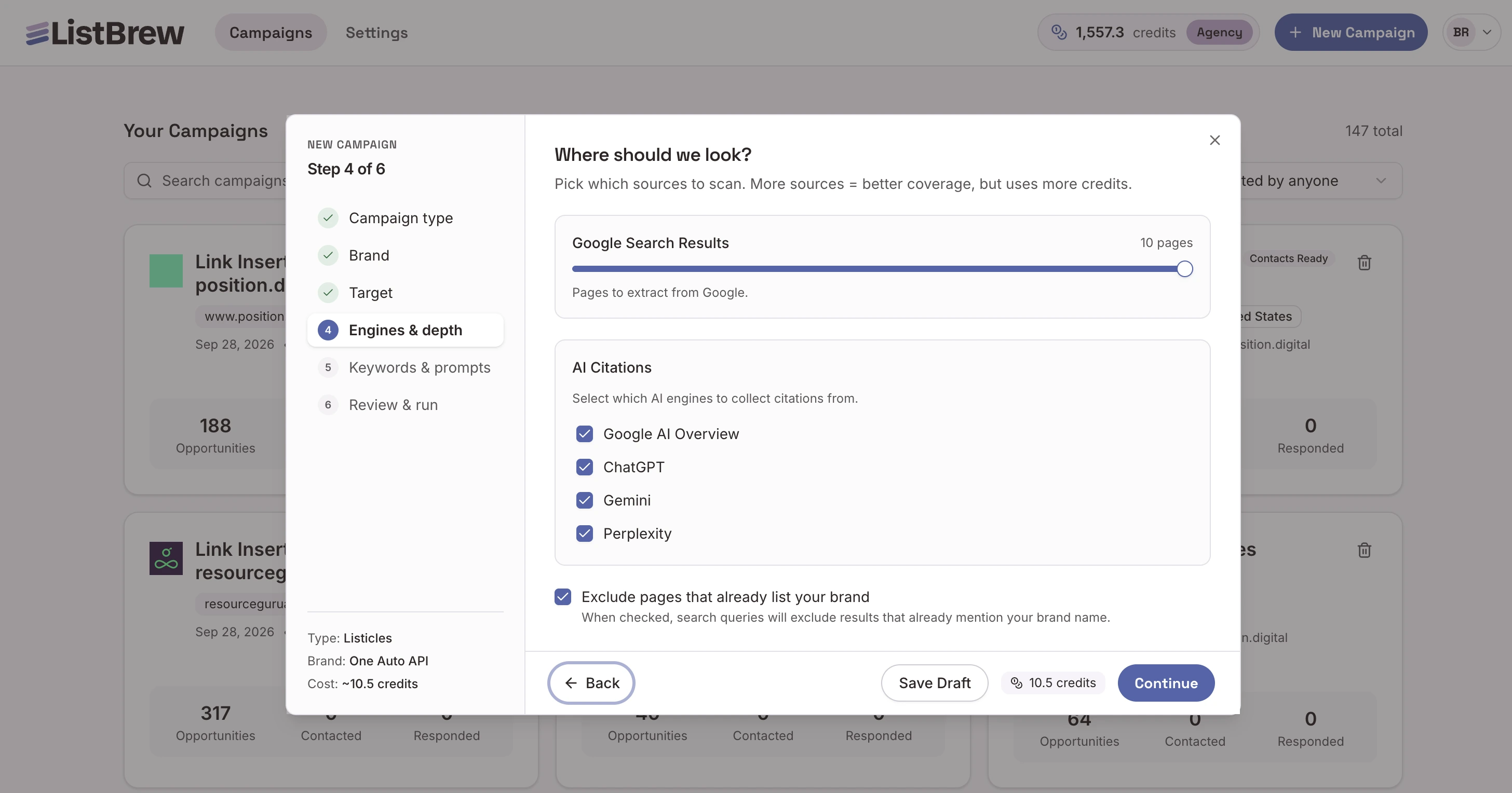
Shortlist your prospects. ListBrew shows each result's domain rating, estimated organic traffic and AI citation recurrence. Run the stand-alone link test above on the best ones. Our starting bar is DR 50+, 1,000 monthly organic traffic and a relevant topic, though it isn't a hard rule.
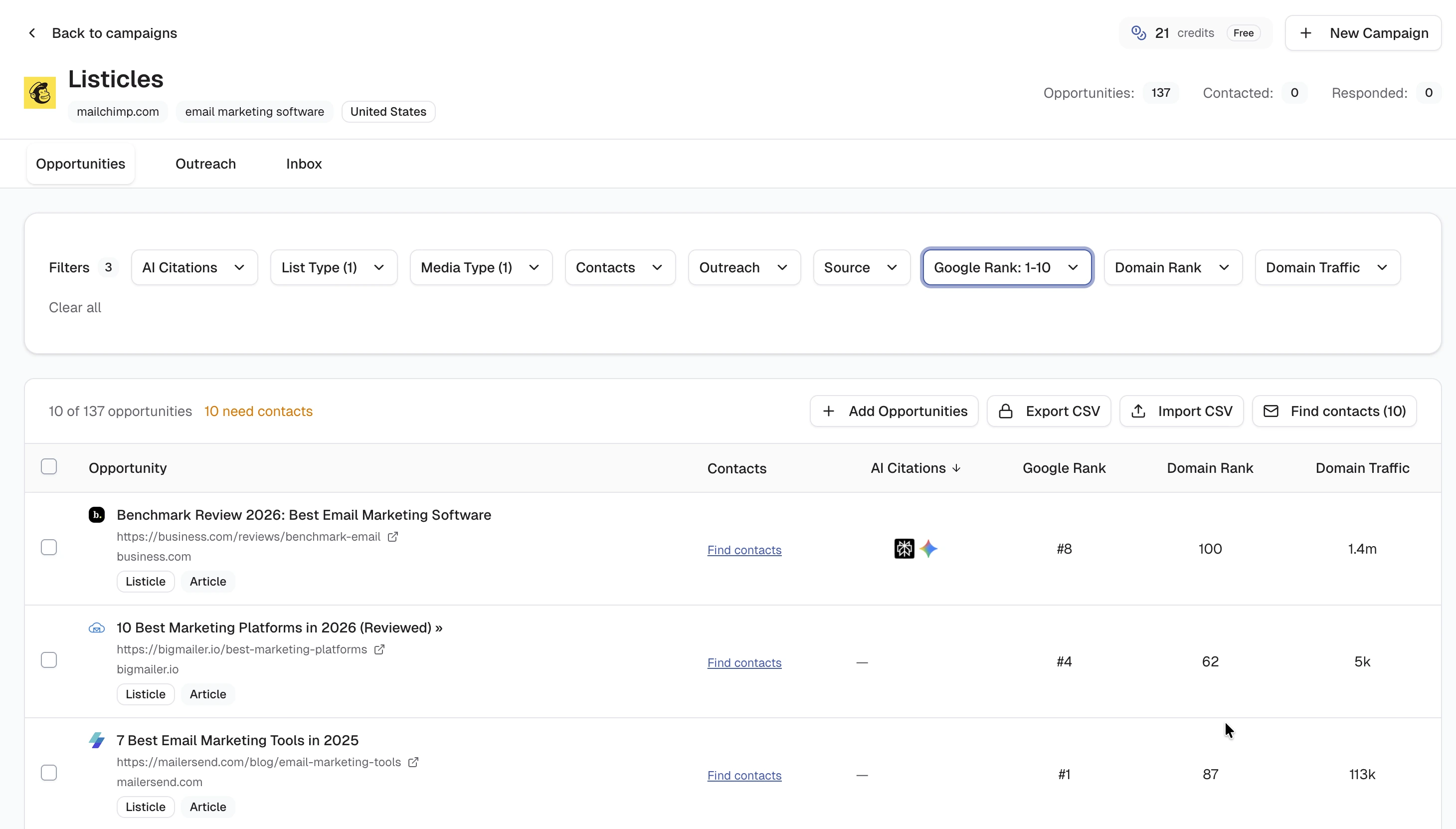
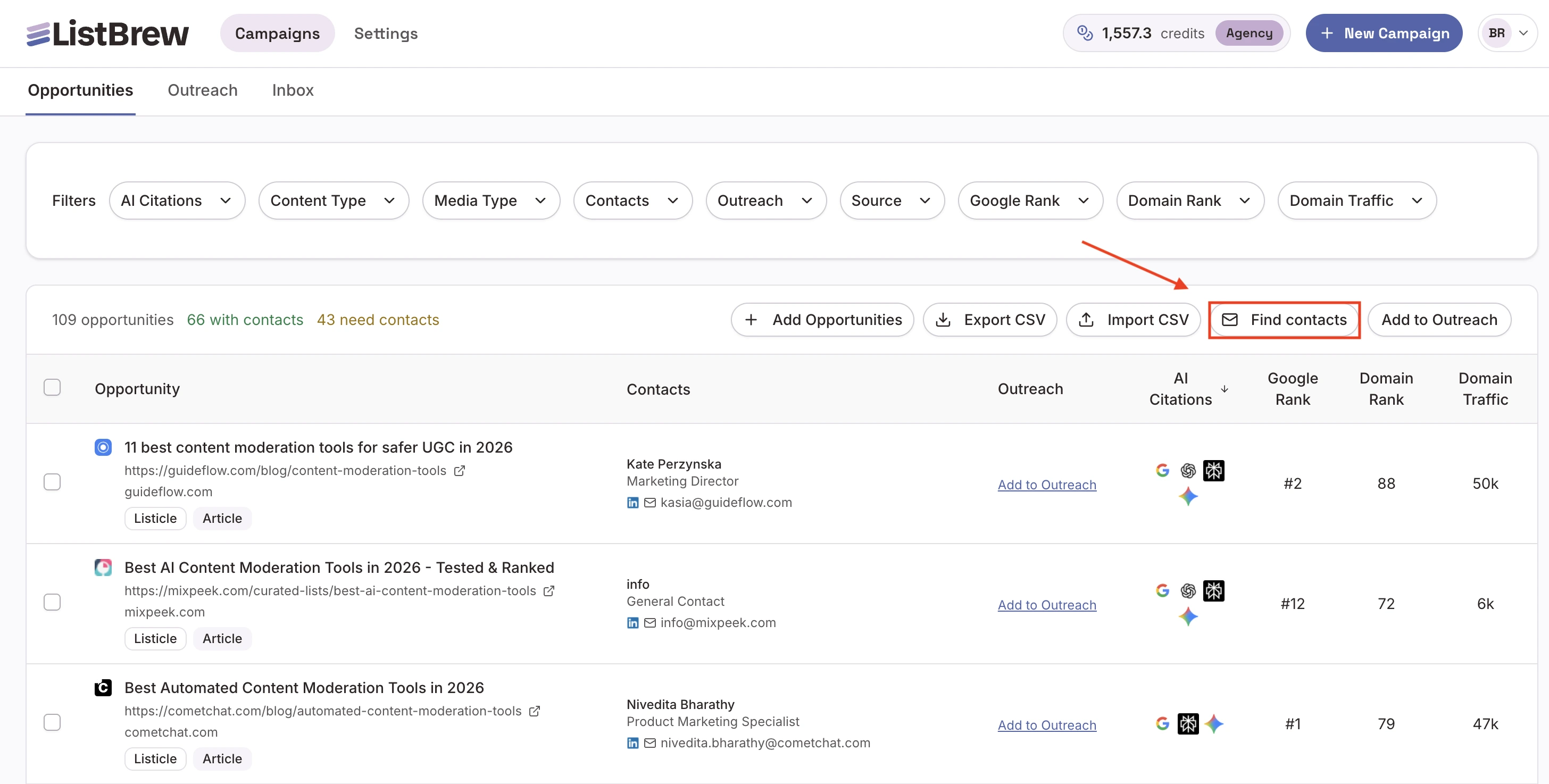
Find the right contact. Click Find contacts, select People by role, and enter roles such as content writer, editor or marketing manager.
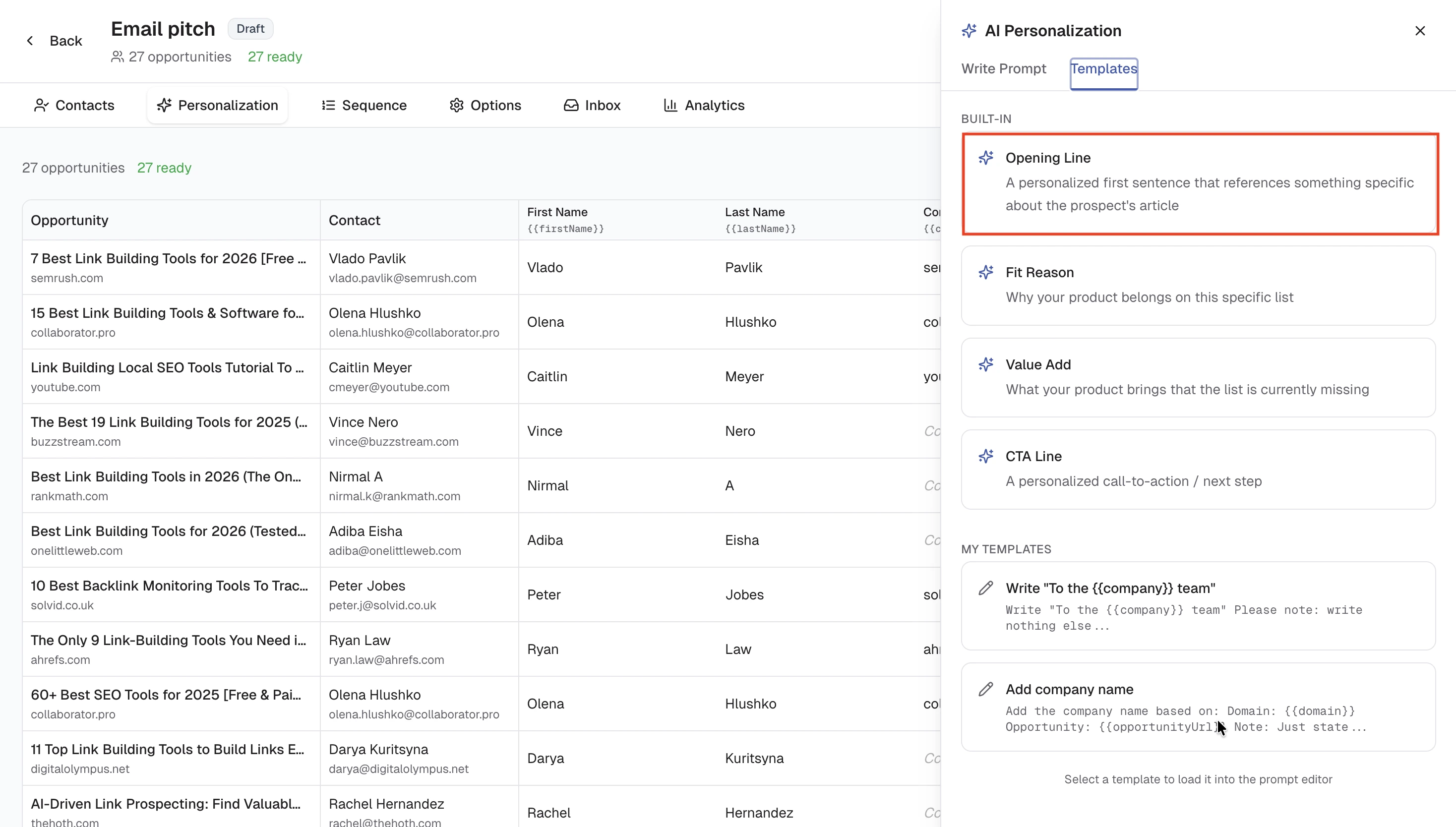
Write the pitch with your offer. Click Add to Outreach, name the sequence, and use the AI feature to personalize your opening line. Then add your return offer, for example: "In return, I'd be glad to link to your article from a relevant post on our blog, or from a guest post we have coming up."
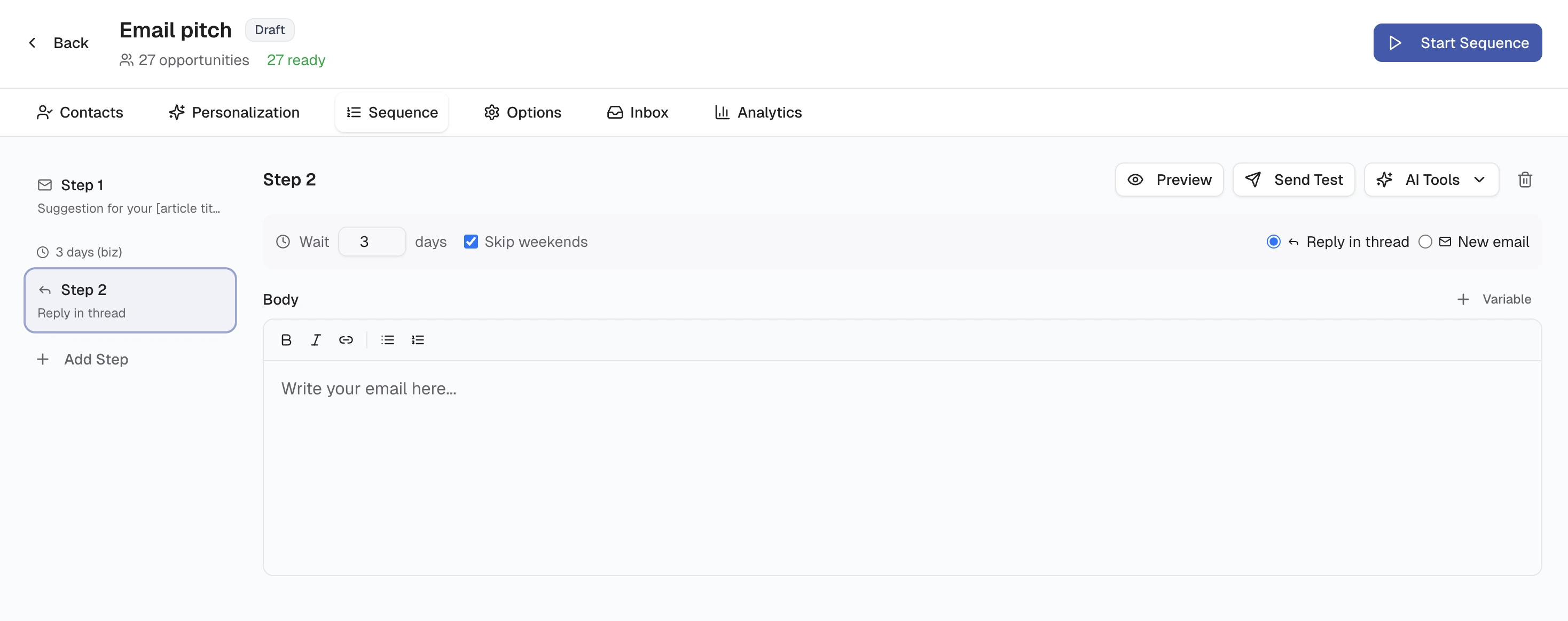
Send the sequence. Build your initial email and follow-ups in the Sequence tab, for example on days 1, 3 and 6.
Agree on the deal. Once a prospect says yes, agree which page gets each link. Then give them your blurb, ask for theirs, and check both before anything goes live.
Publish and track the links. Wait until your link is live before you add theirs. Then note the URL, DR, anchor text and whether the link is follow or nofollow.
Build links you don't have to trade
Every link you earn without a trade is one less deal to track and one less outbound link to give. ListBrew is an AI citation outreach tool that finds pages already influencing LLM answers, and helps you earn a place on them.
It shows each page's Google rank and AI citations, finds the right contact, and runs your outreach in one place.
Create your free ListBrew account and start earning links that don't need a return favor!
Link exchanges FAQ
How many link exchanges are too many?
Link exchanges have no published safe number, because Google hasn't set one. The closest guidance is Mueller's 2021 comment that a manual action becomes possible "if this is the majority of the links" pointing to your site, so keep exchanges a small minority of your profile.
Is buying backlinks illegal?
Buying backlinks isn't illegal, but buying them for ranking purposes breaks Google's spam policies. Google accepts paid links as advertising when they're marked with rel="sponsored" or rel="nofollow", and its link attribute guidance says marked links "will generally not be followed."
What is a link farm?
A link farm is a network of sites built mainly to link to one another and pass ranking signals, with little value for readers. Link farms sit well past an occasional swap, and they fit Google's definition of link spam as links created to manipulate search rankings.
Do backlinks still matter in 2026?
Backlinks still matter in 2026, including for AI search visibility. Our link building study of 1,163 domains found that sites with larger backlink and referring-domain profiles tended to earn more citations across Google AI, ChatGPT and Perplexity. That shows a correlation, not proof of cause.