Seer Interactive recently conducted a study to see which factors correlate with ChatGPT visibility. They found that backlinks from DA 60+ sites and mentions in “best” articles are among the top 3 metrics that move the needle.
The takeaway is clear: if you want your brand to appear in LLM answers, the fastest route is to earn placements in the third-party listicles those models already cite.
In this article, I’ll walk you through the step-by-step listicle outreach process using ListBrew, including finding listicle opportunities, pulling contact information, and sending personalized pitches at scale.
Why listicle outreach is more important than ever
There are two major reasons why listicle outreach is an effective tactic to boost your AI visibility:
Listicles are the most cited content type in LLMs
Wix Studio's analysis of more than one million AI citations found that listicles drive 21.9% of all AI citations and 40.9% of citations on commercial queries — more than any other content format.
When someone asks ChatGPT, Gemini, or Perplexity for a recommendation, the answer almost always comes from listicles.
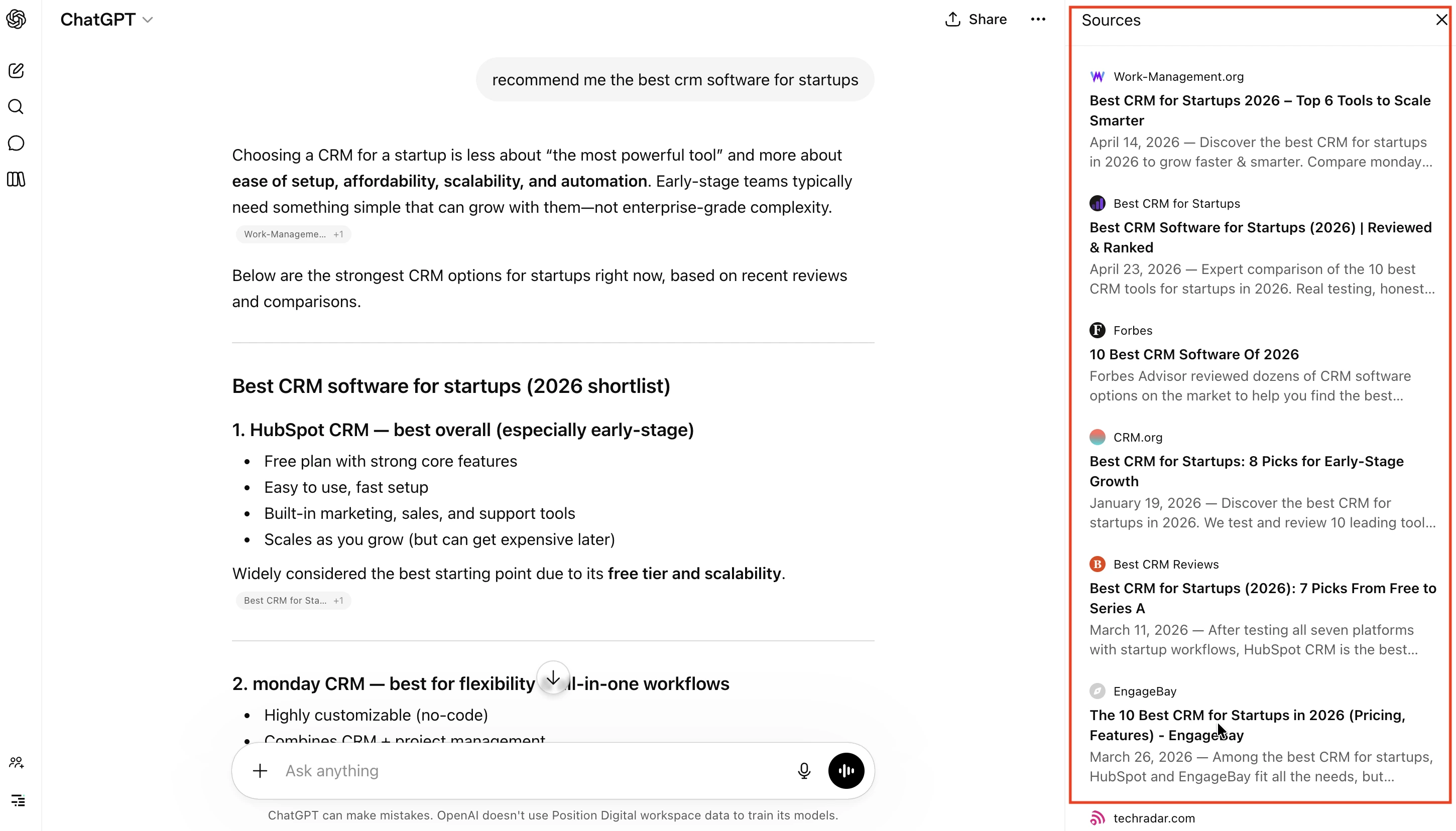
After conducting an analysis of 1,400+ ChatGPT and Perplexity citations for B2B SaaS, a practitioner shared their results on Reddit:
"Over 75% of citations come from listicles and product reviews. If an AI is asked 'What's the best CRM for AI startups?', it doesn't just guess. It looks for a 'Top 10' list that has already done the heavy lifting. If you aren't being mentioned in those third-party 'Best of' guides, you won't show up in the AI reply."
Third party brand mentions are a major AI visibility factor
Being cited by AI engines isn't just about what you publish. It's about where your brand shows up across the web.
Ahrefs found that branded web mentions correlate strongly with AI visibility. The more listicles mention and recommend your brand, the more likely it will appear in AI Overviews, ChatGPT, and AI Mode.
TL;DR: How to do listicle outreach in 5 steps
Define your core themes
Find listicle opportunities
Clean your list
Find contact information
Send a personalized pitch
Step 1: Define your core themes
Before you begin the outreach process, first you need to answer the following question: what categories or themes do you want LLMs to associate your brand with?
This matters because LLMs don't think in keywords — they think in entities and associations.
When a user asks ChatGPT "what's the best project management tool for remote teams?", the model surfaces brands it has repeatedly seen mentioned in that specific context across its training data and live retrieval.
As Ryan Law, Director of Content Marketing at Ahrefs, explained:
“Unlinked mentions—text written about your brand on other websites—have very little impact on SEO, but a much bigger impact on GEO… LLMs derive their understanding of a brand’s authority from words on the page, from the prevalence of particular words, the co-occurrence of different terms and topics, and the context in which those words are used.”
So, how do you define the themes you want to own? Start with three questions.
What are your core product categories? Example: CRM software
Who are your target audiences? Example: CRM software for startups
What are your unique selling points? Example: CRM software for startups with unlimited user seats
A GEO practitioner shared his tip on r/SaaS:
“Build your prompt list. Take 20-30 buying intent queries your prospects would type into AI. Things like "best [your category] for [use case]" or "[competitor] alternatives" or "[tool A] vs [tool B]". Pull them from demo call transcripts, competitor ads, and Google Autocomplete.”
Step 2: Find listicle opportunities
Once you know the themes you want to own, the next step is finding every listicle worth pitching. There are two ways to build that list.
Method 1: Analyze competitors’ backlinks using Ahrefs
Your competitors have already done half the research for you. Every listicle that features a competitor and omits you is a placement opportunity — and Ahrefs makes finding them straightforward.
Here's how to do it:
Open Ahrefs Site Explorer and enter a competitor's domain.
Go to Backlinks and filter by Dofollow links.
Filter the referring page title for pages that contain any of these commercial terms: "best," "top," "alternatives."
Export the results to a CSV file.
Repeat across two or three competitors to build a comprehensive list.
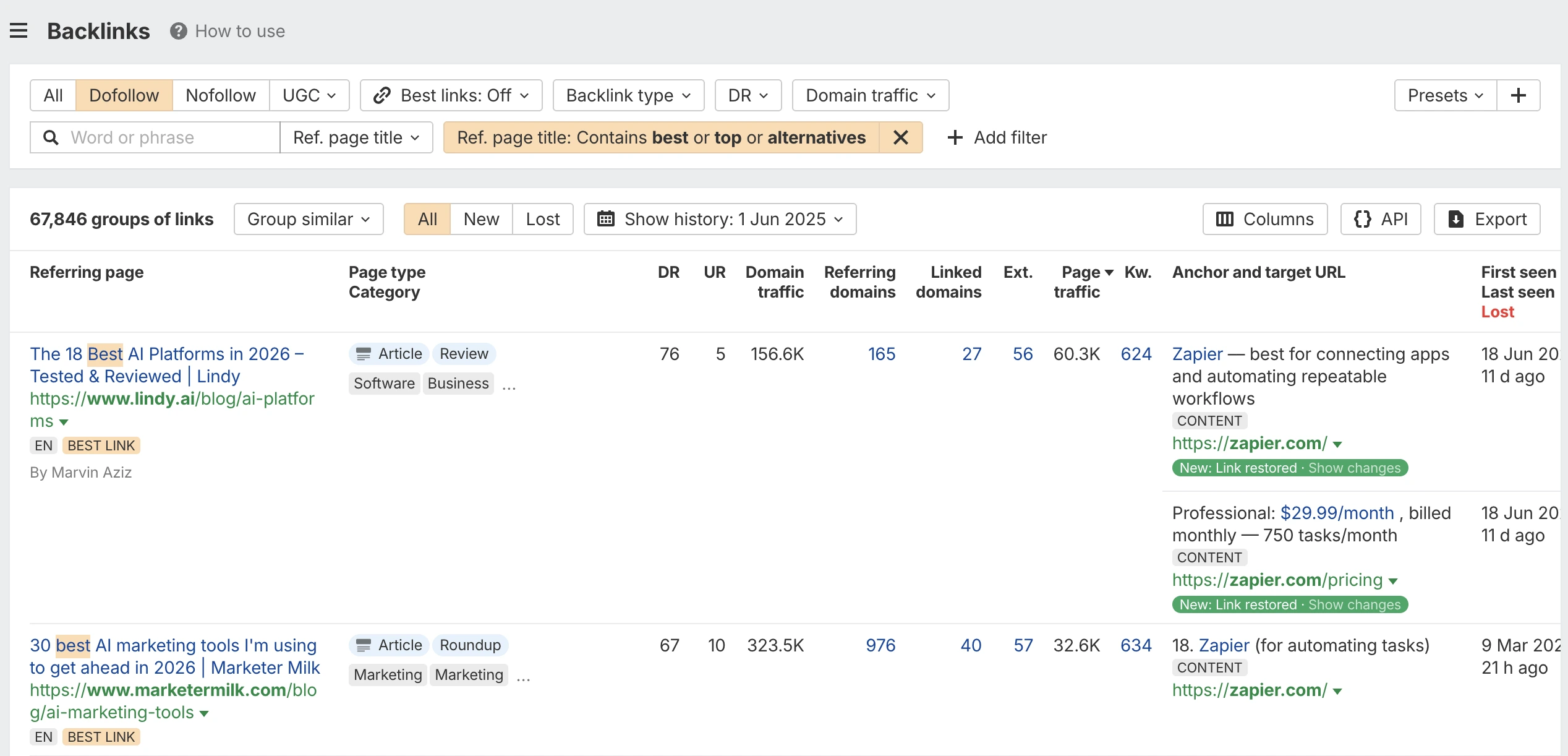
Nikola Baldikov, CEO of SERPsGrowth, suggested setting these filters:
Dofollow only
In-content links
DR 30+
Domain traffic 1000+
Search for words like "best," "top," "tools," or "alternatives"
Language: English (or whatever is appropriate for your target audience)
Method 2: Find listicles that AI already cite using ListBrew
Getting featured in listicles that AI already cites is one of the fastest ways to improve LLM visibility.
ListBrew shows you exactly which listicles are being cited across ChatGPT, Google AI Overviews, Gemini, and Perplexity for the commercial queries you care about.
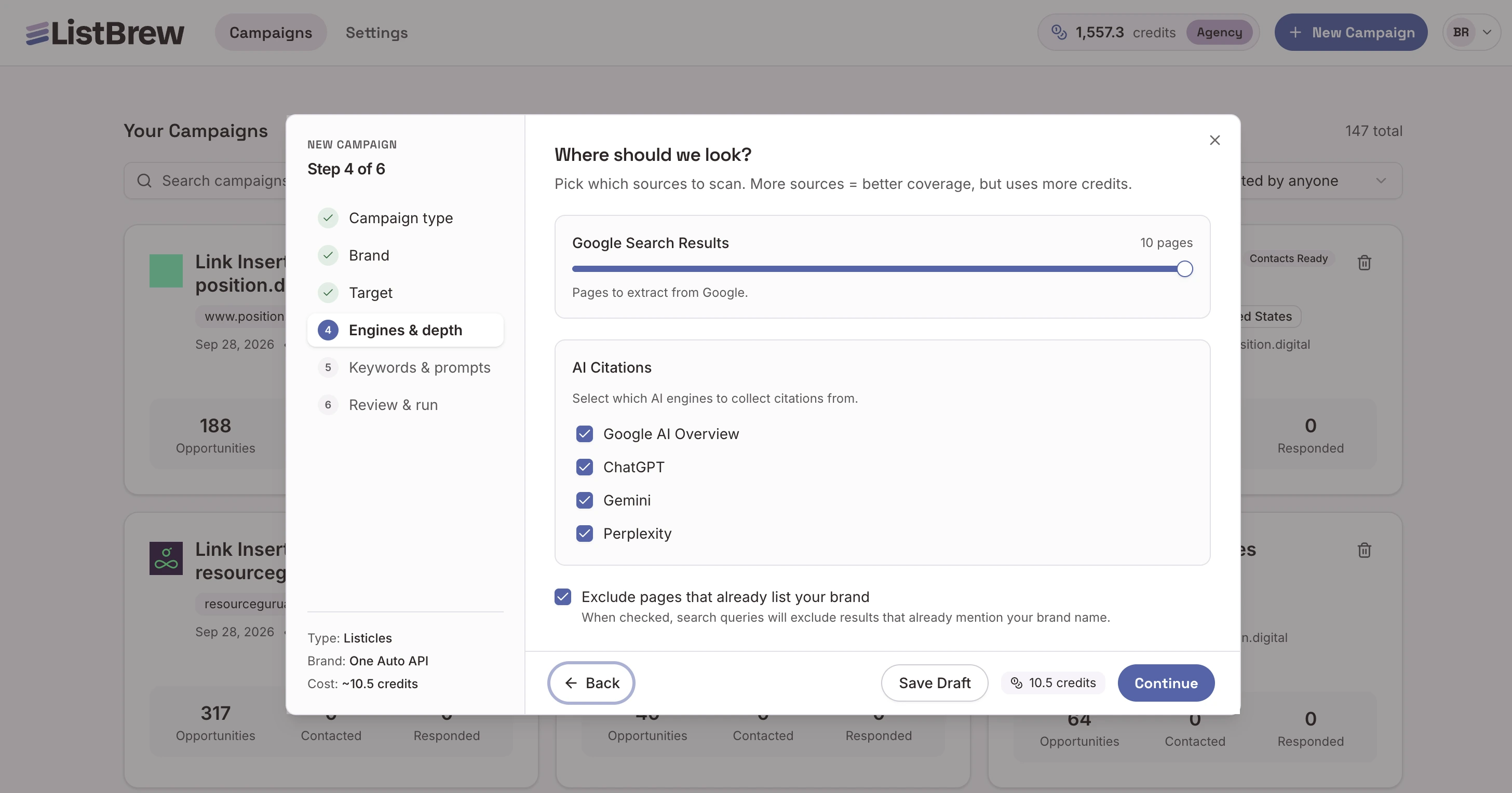
Simply sign up for free and create a campaign:
Choose Listicles as your campaign type.
Set up your brand details.
Type your target listicle keyword: best/top + your category.
Select your target location.
Choose AI engines you want to extract citations from.
Exclude pages that already cite your brand.
ListBrew will give you every listicle that ranks in Google for those queries. Each result is enriched with domain rating, estimated organic traffic, and AI citation recurrence, so you can quickly prioritise the placements that are worth pitching.
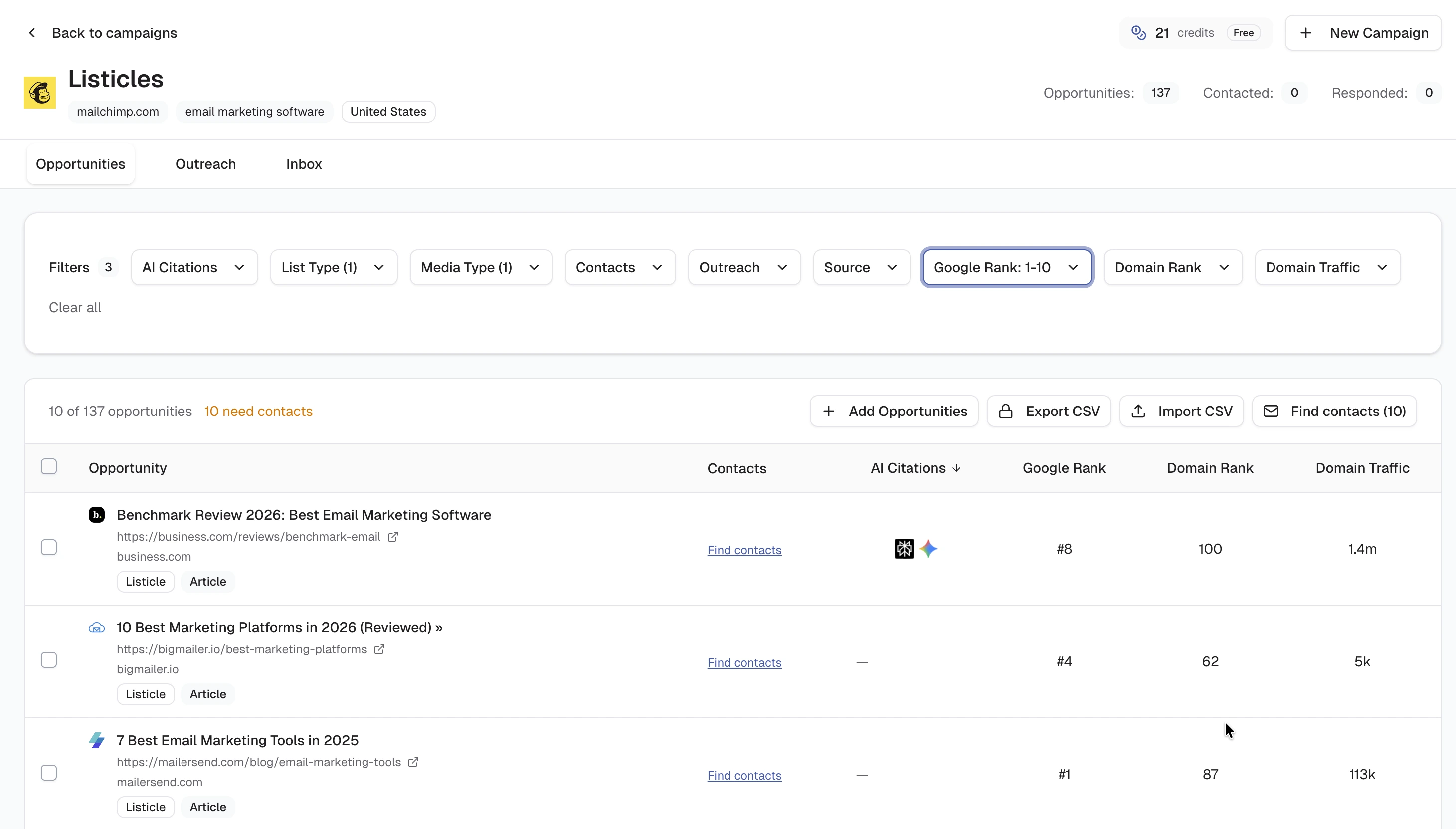
Once you have what you need, export the results to a CSV file.
Step 3: Clean your list
By now, you probably have hundreds of listicles in your CSV files. But not all of them are worth pitching.
Before writing a single email, clean the list and remove weak opportunities. The goal is to narrow your outreach down to pages that are relevant, credible, and likely to influence AI answers.
I usually delete pages that:
Have a low domain rating (below 30)
Rank outside Google’s top 10
Have no organic traffic
Doesn’t match the exact topic you want to be associated with
Look spammy, thin, and generic
Haven’t been updated in 2+ years
Are clearly pay-to-play with no editorial standards
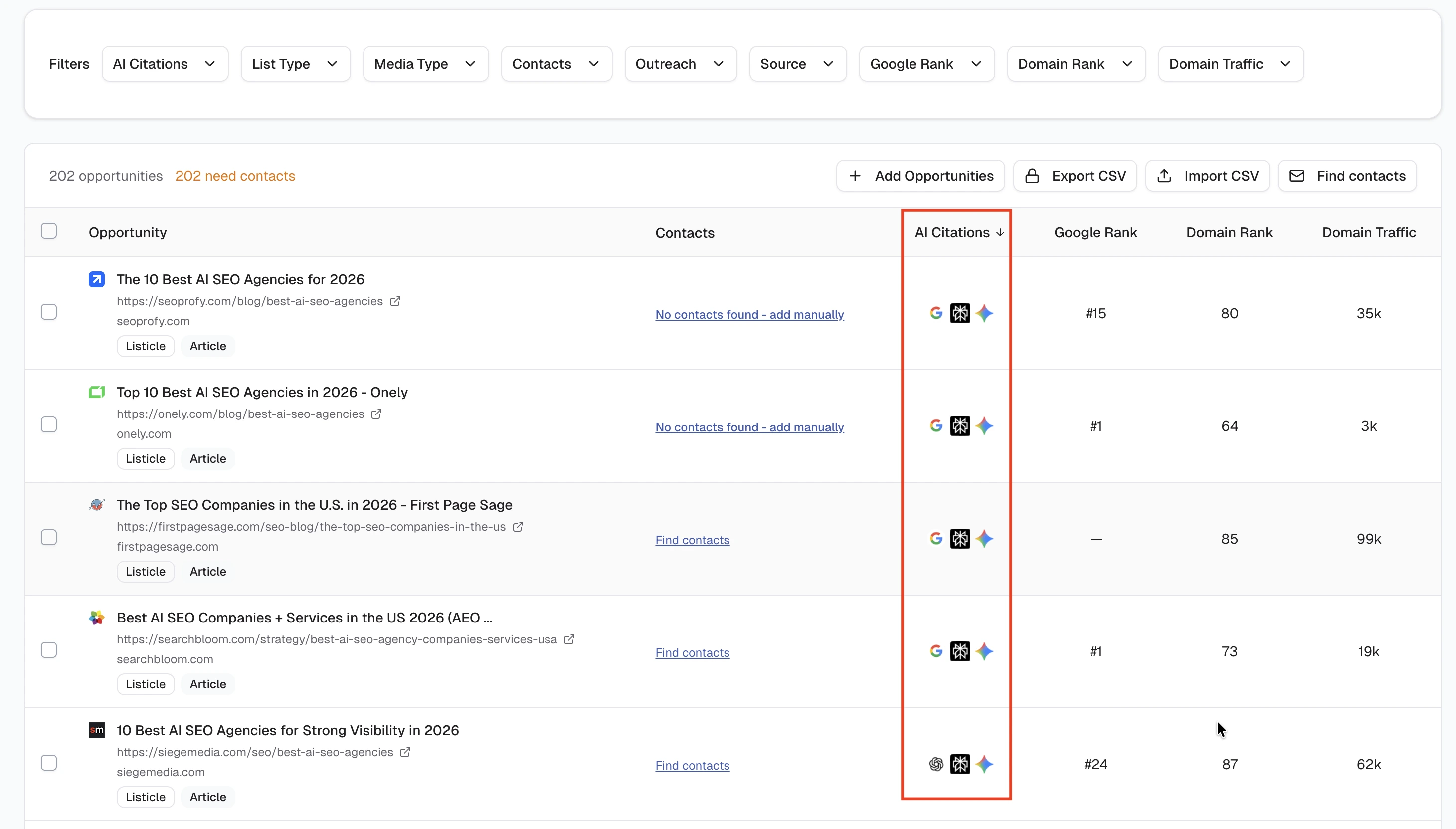
The second layer of filtering is to prioritize listicles that are already cited in AI answers. As James Owen, Co-Founder of Click Intelligence, put it:
“These pages are already being referenced by LLMs, so getting featured on new ones has a direct impact on visibility.”
You can check which listicles are being cited in AI Overviews, ChatGPT, Perplexity, and Gemini directly in ListBrew.
Step 4: Find contact information
Once you have a clean list, the next step is finding the right person to pitch.
Do not send every email to a generic info@ address. Listicle outreach works best when you contact the person who can actually update the article: usually the author, editor, or content manager.
As a marketing consultant put it on r/content_marketing:
“Most listicles are written by freelance contributors or beat journalists who cover specific verticals. If you haven't already, make sure you are reaching out to the actual writer, not just the default "editor@___" email.”
Here’s how to do that in ListBrew:
Click Find contacts at the top of the list to find contact information in bulk.
Select People by role.
Inside the Keywords field, enter relevant terms like content, writer, editor, marketing manager, etc.
Wait a few minutes as ListBrew collects contact details of each domain.
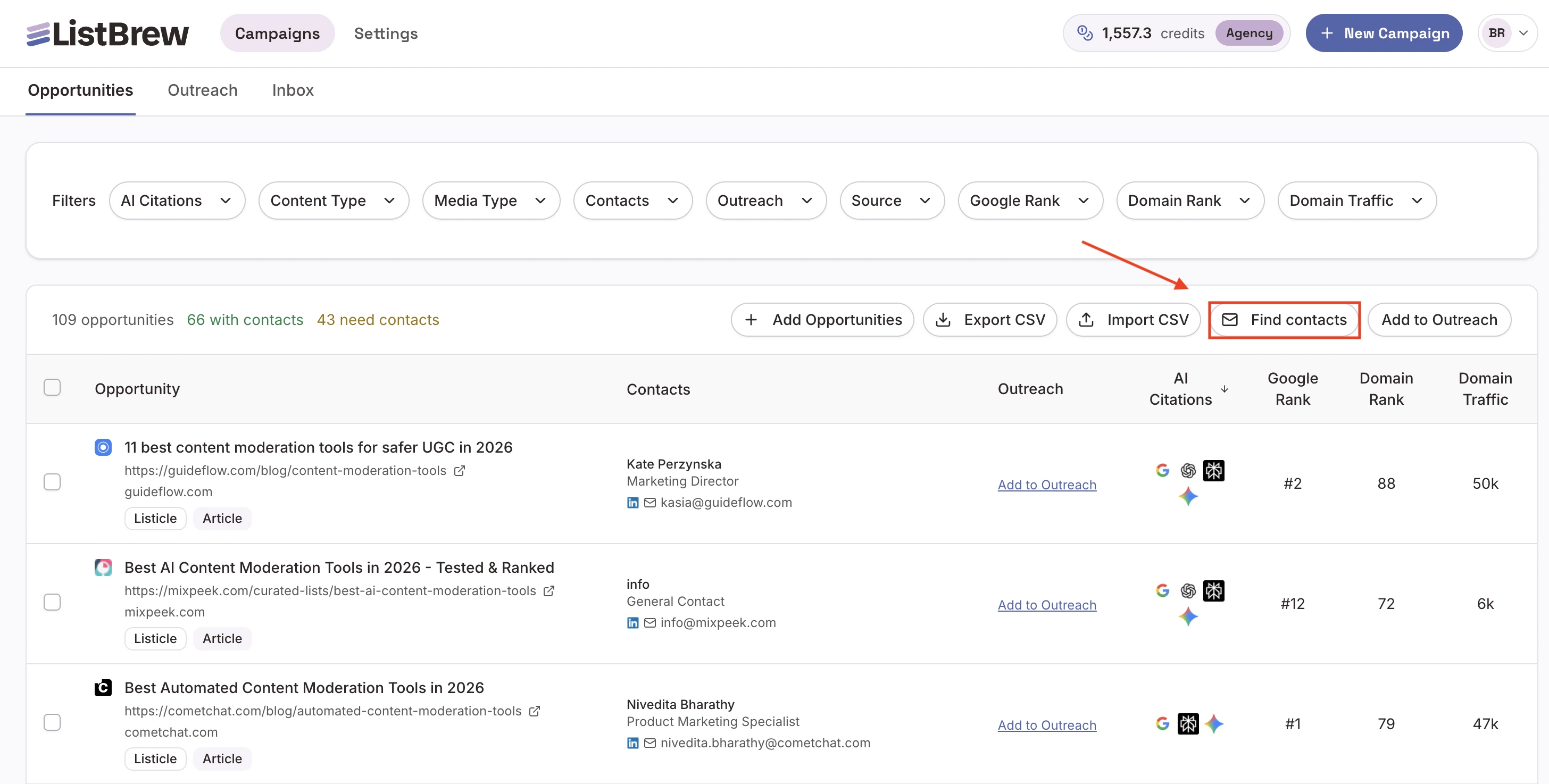
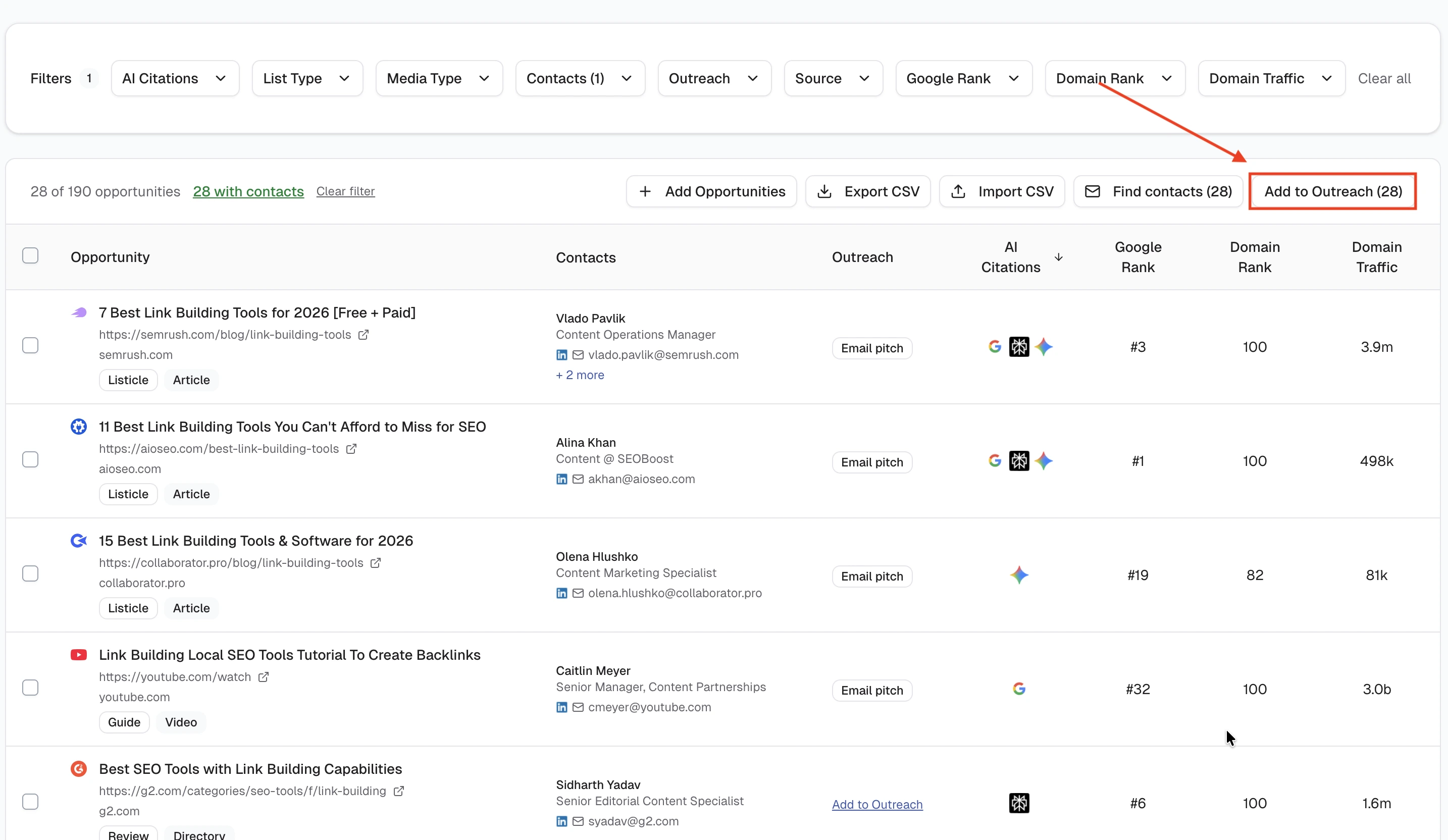
Once you’ve got the contact information for all listicle opportunities, click Add to Outreach at the top of the list. You’ll be asked to create a new outreach sequence.
Step 5: Send a personalized pitch
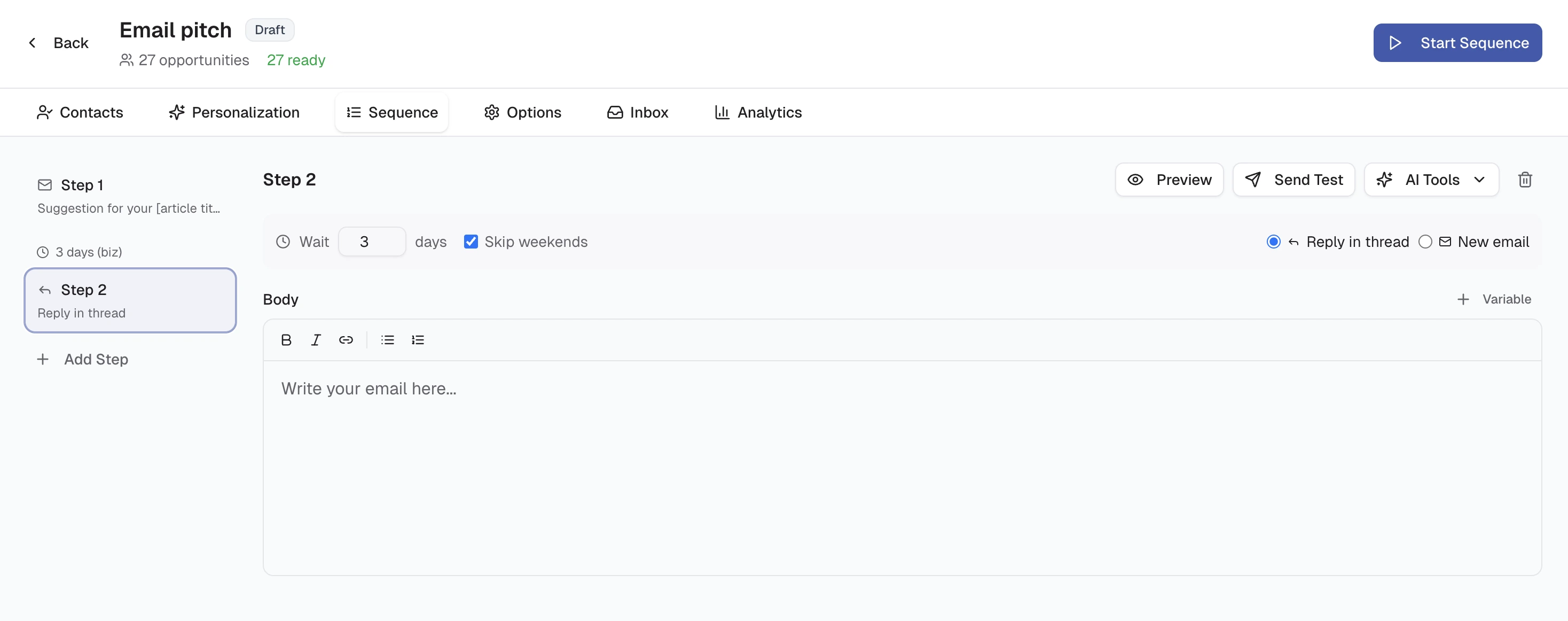
Go to the Outreach tab and select the sequence you’ve just created. From there, you can build your email sequence.
For example:
Step 1. Send initial email — Day 1
Step 2. Follow-up if no reply — Day 3
Step 3. Final follow-up if still no reply — Day 6
For the initial email, don't send a generic “please add us to your list” message. Editors get these all the time, and most are easy to ignore.
Here’s a good tip from Nikola Baldikov:
“What I like to do is reference something specific in their article, explain why your tool deserves a spot, and make it easy for them to plug in your blurb.”
A strong pitch should include:
The exact article you are referencing
The category or use case your brand fits into
Why your brand is relevant to that list
What gap can your product fills
What unique value you bring to the table
Here’s a simple template you can use:
Subject: Suggestion for your [article title]
Hi [Name],
I was reading your listicle on [topic] and noticed you cover [relevant point].
One gap I spotted: [specific gap].
We might be a useful fit for the list because [clear differentiator]. In one line, [Brand] helps [audience] do [job to be done].
In case helpful, here’s a short description you could use or adapt:
[40–80 word blurb]
Happy to send over a shorter version, product details, quotes, or a headshot if needed.
In exchange for the inclusion, I’m willing to [offer something in return].
Let me know if you’re interested!
Best,
[Name]
Irina Maltseva, former Head of Marketing at Hunter, shared some tips to get your pitch accepted:
Provide blurbs for the listicle. Many bloggers are busy and often have established content update schedules. If you don’t want to wait a year for the next update, offer to help.
Offer something in return. Help spread the word about the updated article, share advice in your area of expertise, provide a backlink from your upcoming guest post, etc.
Always follow up. People are busy, and they can forget about you—it’s OK. If they showed interest in your offer, don’t hesitate to remind them about yourself.
Common mistakes to avoid when doing listicle outreach
Avoid these common pitfalls when running your listicle outreach campaigns:
Leading with your product instead of their article
The most common opening line in listicle outreach is some variation of "Hi, I'd love to be featured on your list." That sentence tells the editor nothing about why they should care — and everything about why they shouldn't reply.
Lead with something specific to their article: a data point that's out of date, a category they haven't covered, a tool they ranked incorrectly. Show you've read the piece before you ask for anything.
Sending the same template to everyone
Editors recognize templated emails on sight. The giveaway is always the same: a compliment that could apply to any article, a pitch that makes no reference to the specific list, and a CTA that reads like a mail merge.
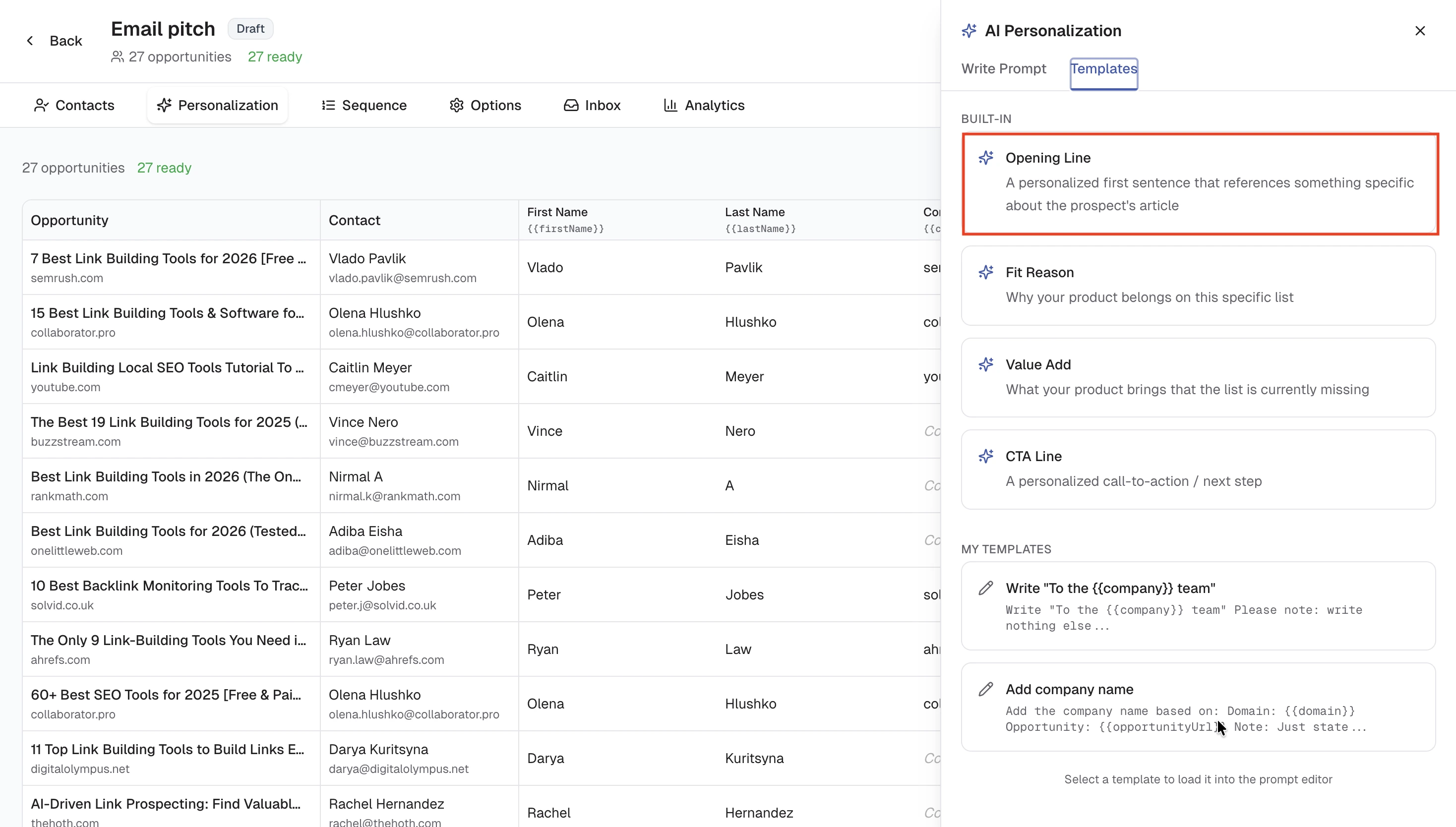
Personalization doesn't mean rewriting every email from scratch — it means changing the first two sentences to reflect something specific about the article you're pitching.
In ListBrew, you can use our built-in AI feature to pull relevant details about each listicle and personalize your opening line.
Asking for too much too soon
Requesting a #1 ranking in the first email is the outreach equivalent of asking someone to marry you on a first date. Editors who don't know your brand aren't going to hand you the top spot.
Ask for inclusion first. Once you've built a relationship and given them reasons to rank you higher, then you can ask for a higher position.
Following up too aggressively
Three touchpoints should be the ceiling: one initial email and two follow-ups. If the person still has not replied, stop there. A fourth email is unlikely to change their mind and might even increase the risk of being marked as spam.
Kickstart your listicle outreach campaign with ListBrew
Finding the right listicles, identifying contact details, and sending a personalized pitch manually can take hours or even days.
ListBrew speeds up the entire process.
In just a few minutes, you can:
Discover every listicle ranking for your target keywords
See which pages are already cited by ChatGPT, Google AI Overviews, Gemini, and Perplexity
Find the right contacts for each opportunity
It’s also easy to set up your email sequence, track replies, and see the status of each pitch—all in one dashboard.
Start free today. No credit card needed.
FAQs
What is listicle outreach?
Listicle outreach is the process of getting your brand added to relevant third-party listicles, such as “best X tools,” “top X agencies,” or “[competitor] alternatives” articles.
This is crucial for LLM visibility, considering that brands are 6.5x more likely to be cited through third-party sources than their own domains. (Airops)
How do I prioritize which listicles to go after first?
Prioritize listicles that already rank in Google’s top 10 and appear at least in one of the following AI engines: AI Overviews, AI Mode, ChatGPT, Gemini, and Perplexity. ListBrew is the right tool for that.
Should I pay for listicle placements?
No. If a web owner accepts paid placements, it means they don’t care about the quality of their content, as long as they can make quick money. Paying for a do-follow link is also against Google’s spam policies, as it’s considered a scheme to manipulate search rankings.
What is the best way to scale outreach for top listicles?
If you want to speed up your listicle outreach process, use tools like ListBrew. It helps you find relevant listicles, identify AI-cited pages, find contacts, and manage your outreach workflow in one place.