Link building is the most effective strategy to boost your AI visibility. The more sources link to your site and mention your brand, the more trust signals you build with AI engines.
We combined our own analysis with recent industry research to compile 20 link building statistics you should know in 2026.
Key takeaways
Demand for link building is rising fast. Search interest for “link building services” increased by 518% between August 2024 and August 2026, while 58% of SEO professionals increased their link building budgets for 2026.
Backlinks still have a strong relationship with organic rankings. Pages ranking in the top three had nearly 5x more backlinks and 2.3x more referring domains than pages ranking in positions 4 to 10.
Off-site authority also appears to matter in AI search. In our analysis of 1,163 domains, sites with larger backlink and referring-domain profiles tended to earn more citations across Google AI, ChatGPT, and Perplexity.
Third-party placements can be particularly valuable for AI visibility. Brands appearing in at least 40% of the listicles within ChatGPT's source pool received nearly 8x more mentions than brands with no listicle presence.
Outreach remains difficult, so personalization matters. 91.5% of cold outreach receives no reply, but personalizing the email body can increase response rates by 32.7%, while following up can lift them by 65%.
The state of link building in 2026
The link building industry is growing fast, as seen in the following trends:
The global link-building market size is valued at $30.32 billion in 2026
And it’s not slowing down, either. The link building market size is expected to reach $35.51B in 2027, and $57.07B by 2030.
Year | Estimated link building market size |
|---|---|
2024 | $22.81B |
2025 | $25.97B |
2026 | $30.32B |
2027 | $35.51B |
2028 | $41.58B |
2029 | $48.69B |
2030 | $57.07B |
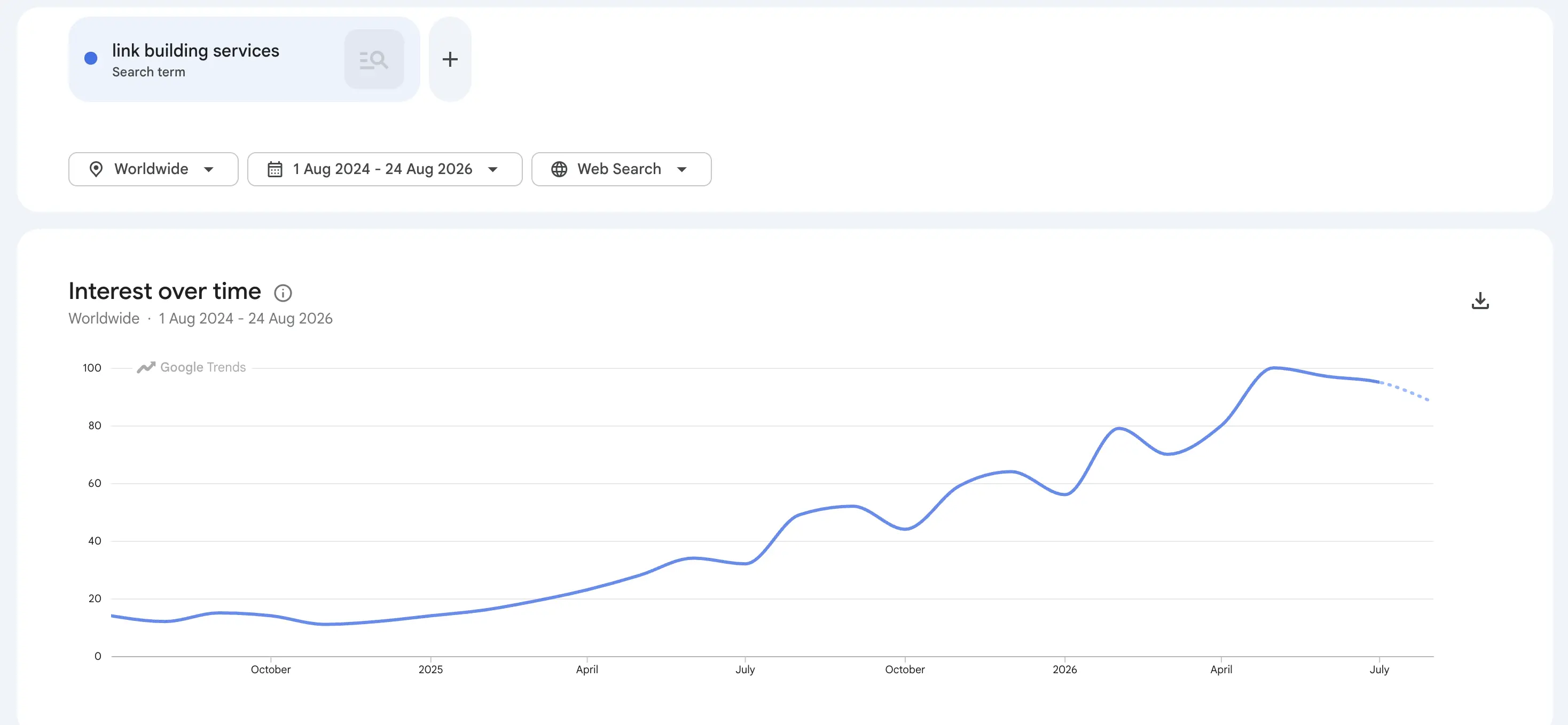
Demand for link building services has grown by 518% in the past 2 years
More companies appear to be investing in their off-site presence as AI search becomes a bigger part of the discovery journey.
We looked at Google Trends data for three link building terms between August 2024 and August 2026.
Interest increased across all three:
“Link building” increased by 339%
“Link building services” increased by 518%
“Link building agency” increased by 227%
Teams are increasing link building budget for 2026
Companies aren't just showing more interest in link building. Those already investing in it are increasing their budgets for 2026.
According to a Reporter Outreach survey, 58% of SEO professionals increased their 2026 budget compared to 2025. Only 14% decreased their budget.
64% of SEO teams now spend at least $3,000 per month on backlinks, while 38% spend $6,000 or more.
Link building costs in 2026
Link building costs vary significantly depending on the type of placement, the authority of the publisher, and whether you buy links directly or work through an agency or marketplace.
Based on pricing data from BuzzStream, uSERP, Adsy, and other industry surveys, a single link can cost anywhere from a few dollars to more than $1,000.
Backlinks cost between $150 and $750 per placement
Simple placements such as directory citations sit at the bottom of the market, while editorial links from authoritative publications and digital PR campaigns command much higher prices.
For most common link-building tactics, however, expect to pay somewhere between $150 and $750 per placement.
Link type | Avg / median | Typical range |
|---|---|---|
Link insertion / niche edit | $179–$225 | $150–$400 |
Guest post — direct bought from the site | $295 | $100–$500 |
Guest post — marketplace via vendor/broker | $459–$461 | $150–$1,000 |
Listicle / "best-of" placement | $450 | $250–$750 |
Digital PR — cost per press coverage | $597 | $400–1,200+ |
Editorial placement on DR60+ news outlets | $1,100 | $700–1,500 |
Directory submission | Free–$15 | Free–$300/yr |
Retainer link building services cost between $500 and $20,000 per month
Buying an individual placement is only one option. Companies can also outsource the entire process to an agency or freelancer, covering prospecting, outreach, content creation, negotiation, and reporting.
Model | Typical range |
|---|---|
Retainer — small / local | $500–$2,000/mo |
Retainer — mid-market | $3,000–$10,000/mo |
Retainer — enterprise | $10,000–$20,000+/mo |
Per link — editorial (agency) | $300–$750/link |
Per link — digital PR / premium | $1,000–$1,500+/link |
Fixed packages | $375–$6,000 |
Hourly — freelancer | $72/hr |
Hourly — agency | $99–$148/hr |
DIY tools | $49–$675/mo |
For ongoing campaigns, mid-market agency retainers typically fall between $2,000 and $10,000 per month, while enterprise campaigns can exceed $20,000.
Companies paying per link can expect roughly $300 to $750 for standard editorial placements and $1,000 or more for premium links and digital PR.
The cheapest option is running outreach internally. Link-building software like ListBrew can cost as little as $49 per month.
The impact of backlinks on AI search visibility
As AI search becomes part of the discovery process, link building and digital PR prove to be the most effective way to get your brand noticed.
Domains with stronger backlink profiles tend to get more AI citations
We analyzed 1,163 domains and 3,837 citations across Google AI, ChatGPT, and Perplexity using our partner tool OpenLens. We then used Ahrefs to populate the backlink data of each domain.
The pattern is clear: domains with more backlinks and referring domains tend to earn more AI citations.
Websites with less than 100 referring domains averaged 1.5 citations, compared to 4.36 citations for websites with over 10,000 referring domains.
Backlinks | Citations/domain | Ref. domains | Citations/domain |
|---|---|---|---|
10M+ | 5.45 | 1M+ | 16.69 |
1M–9,999,999 | 4.43 | 100k–999,999 | 4.12 |
100k–999,999 | 3.29 | 10k–99,999 | 4.36 |
10k–99,999 | 3.83 | 1k–9,999 | 2.85 |
1k–9,999 | 2.72 | 100–999 | 2.91 |
<1,000 | 1.53 | <100 | 1.50 |
But there are a few important takeaways:
Referring domain diversity appears more closely associated with AI citations than raw backlink volume. A site with millions of links from a relatively small number of sources may not carry the same signal as one mentioned across a much broader range of websites.
The relationship isn't perfectly linear. For example, domains with 10k–99,999 backlinks averaged more citations than those in the 100k–999,999 bracket. Similar small reversals appear in the referring-domain data. Backlinks clearly aren't the only factor determining whether a source gets cited.
The biggest jump happens among the most authoritative domains. Sites with 1M+ referring domains averaged 16.69 citations, nearly four times the 4.12 citations recorded for the bracket immediately below them.
This doesn't prove that building backlinks directly causes an increase in AI citations. Larger, more established domains are also more likely to publish authoritative content, rank prominently in search and be referenced across the web.
But it does add to the evidence that off-site authority and web-wide presence matter in AI search. If you want your content cited by AI engines, earning links and mentions from a diverse range of relevant websites should remain part of the strategy.
The top 3 ranking pages have nearly 5x more backlinks than the rest
We analyzed 99 keywords across 12 B2B firms, SaaS brands, and eCommerce stores, comparing the pages ranking in the top 10 positions.
Pages ranking in the top three had a median of 29.75 backlinks, compared with just 6 backlinks for pages in positions 4–10. That's a 4.96x difference.
The same pattern appeared with referring domains. Top-three pages had a median of 11.5 referring domains, more than double the 5 recorded for positions 4–10.
Metric | Top 3 | Pos 4–10 | Lift |
|---|---|---|---|
Referring domains to page | 11.5 | 5 | 2.3× |
Backlinks to page | 29.75 | 6 | 4.96× |
URL Rating | 5.5 | 4 | 1.38× |
Domain Rating | 59 | 69.25 | 0.85× |
Interestingly, Domain Rating showed the opposite pattern. Pages in the top three came from domains with a median DR of 59, while pages ranking fourth to tenth had a higher median DR of 69.25.
This suggests that page-level authority may matter more than overall domain authority when competing for the highest positions.
A page doesn't necessarily need to sit on the strongest domain in the SERP, but it does appear to benefit from having more links pointing directly to it.
Domain Rating is the top factor influencing ChatGPT citations
Domain Rating doesn’t impact organic rankings, but it does impact ChatGPT visibility.
According to a ChatGPT ranking factors study by Position Digital, 42.6% of all ChatGPT citations came from domains with a DR of 80 or higher. The median cited source had a DR of 79.
Domain rating | Citation share |
|---|---|
DR 80+ | 42.6% |
DR 60–79 | 19.8% |
DR 40–59 | 10.6% |
DR 20–39 | 10.9% |
DR 1–19 | 10.8% |
DR 0 | 5.3% |
A DR 80+ domain is also cited 2.1x more often than a DR <40 domain. ChatGPT appears to favor sources from websites with strong domain-level authority.
Listicle links are the biggest driver of brand mentions in ChatGPT
The same Position Digital study also found that third-party listicle presence had the highest correlation with brand mentions in ChatGPT answers.
Brands featured in 40% or more of the listicles in ChatGPT’s source pool received nearly 8x more mentions than brands with no listicle presence.
Here’s the breakdown:
Listicle presence | Avg. mentions | % of answers naming them | % reaching 10+ mentions |
|---|---|---|---|
0 (absent) | 2.6 | 6% | 0% |
1–9% | 4.2 | 9% | 10% |
10–24% | 7.3 | 15% | 21% |
25–39% | 10.8 | 25% | 30% |
40%+ | 20.5 | 47% | 100% |
The pattern is clear: the more third-party listicle placements you secure, the more likely ChatGPT will recommend your brand.
You can use ListBrew to find the top-cited listicles, roundups, and comparison pages in your niche, and send personalized pitches to get included there.
Backlink quality and diversity matter more than sheer volume
Domains that win in AI search aren’t those with the most numbers of backlinks.
According to a Semrush study, brands that consistently appear in AI-generated answers have a combination of good backlink quality and referring domain diversity.
Digital PR statistics
Digital PR is the most important link building tactic in the era of AI search. The more your brand appears online, the more likely LLMs will recognize, trust, and recommend you.
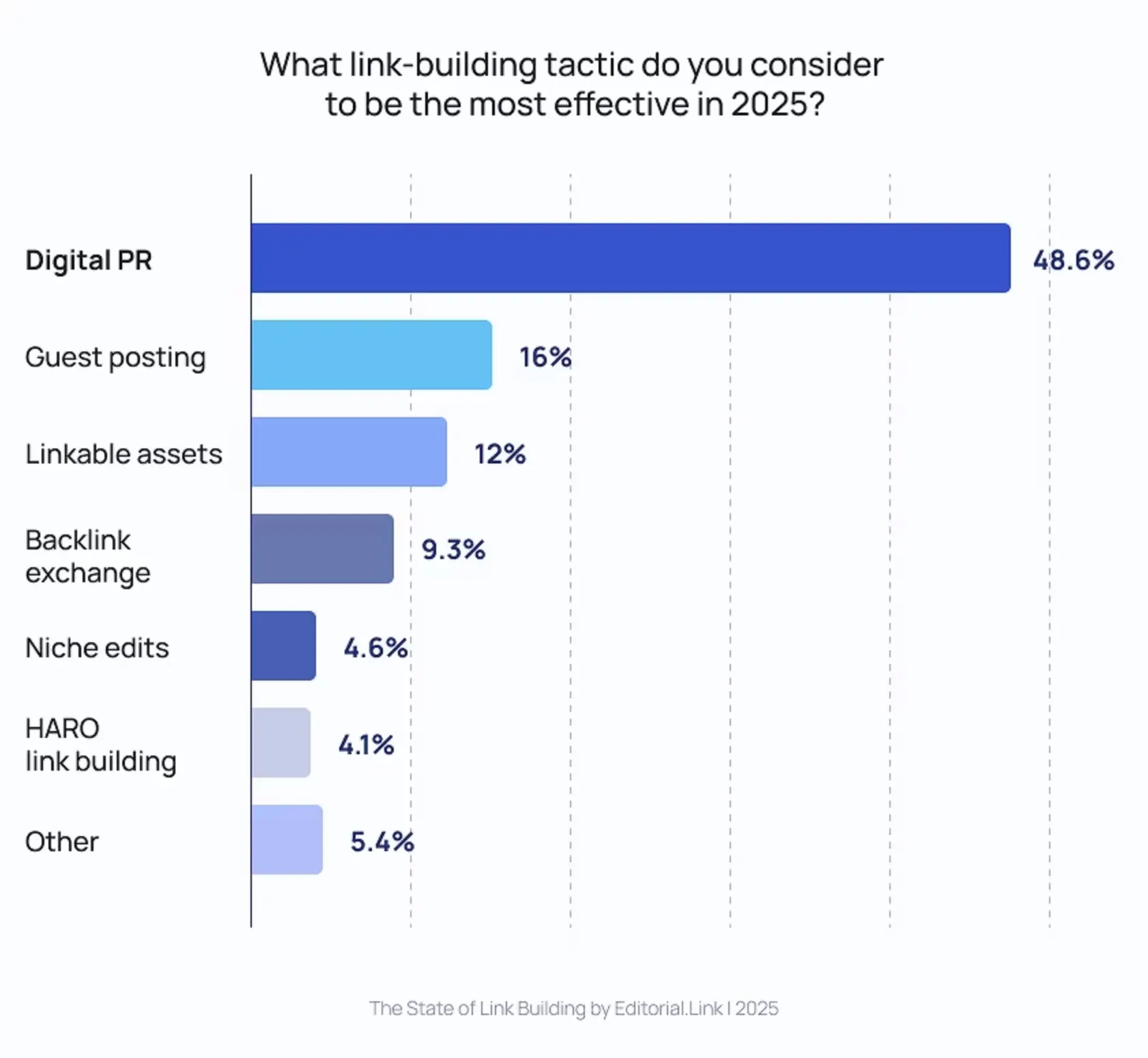
48.6% of SEOs said that digital PR is the most effective link building tactic
Digital PR is seen as the most effective link-building tactic for 2026, chosen by 48.6% of respondents — far ahead of guest posting (16%) and creating linkable assets (12%).
This is based on a survey of 518 SEO professionals conducted by editorial.link.
66.6% of SEO professionals also prefer finding unique backlink opportunities, rather than replicating the backlinks of their competitors.
84% of AI citations come from third-party sources than the brand’s own domain
For years, brands invested primarily in their own domains — blogs, resource hubs, pillar pages — on the assumption that more owned content meant more visibility.
In AI search, that logic inverts. LLMs retrieve information from the broader web. They treat third-party editorial coverage as a proxy for credibility in a way that self-published content cannot replicate.
According to Muck Rack, 84% of AI citations come from earned media rather than your own website.
Airops also found a similar finding: brands are 6.5x more likely to be cited through third-party sources than their own domains.
YouTube presence and branded web mentions correlate most with AI brand visibility
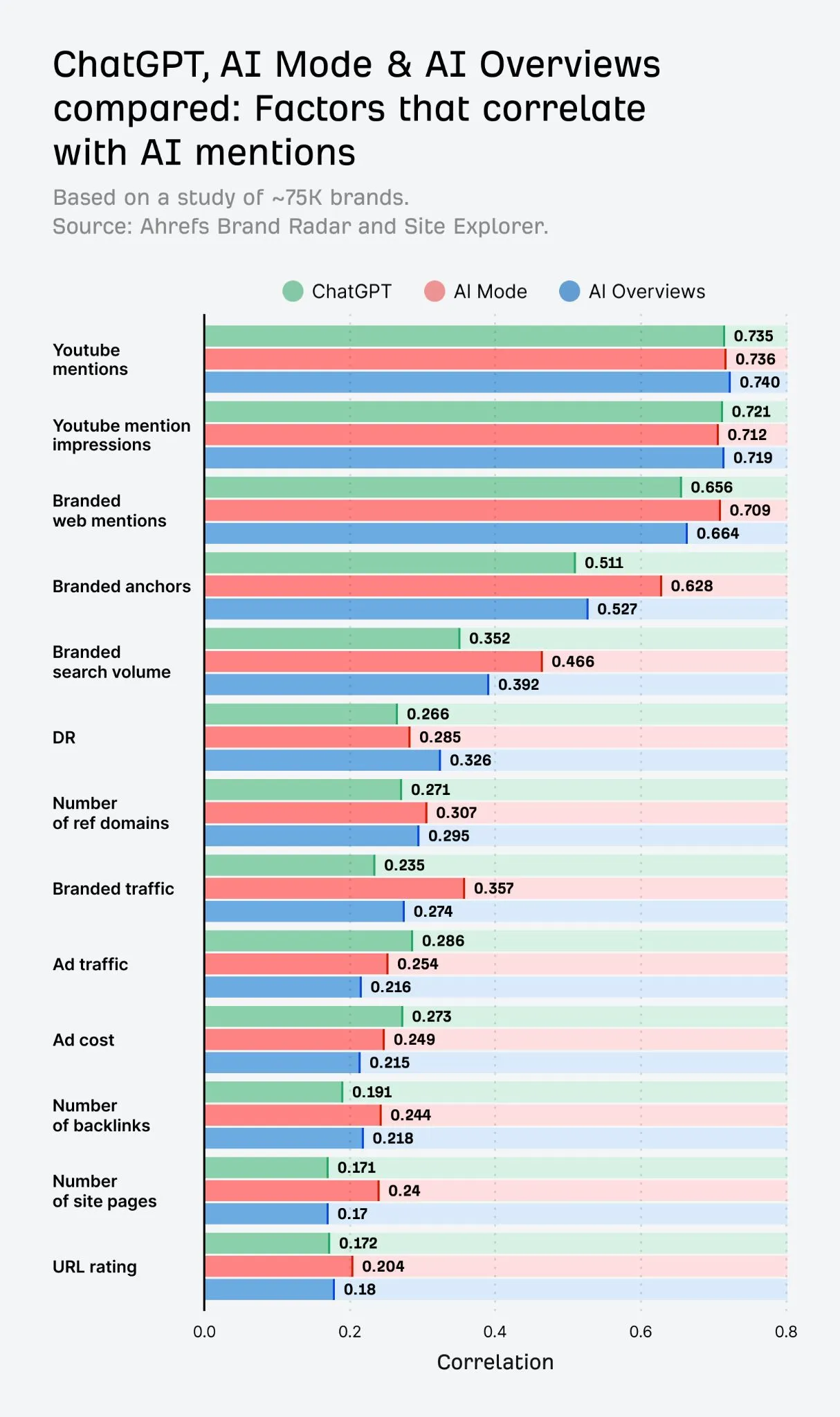
A study of 75,000 brands by Ahrefs found that YouTube mentions, YouTube impressions, and branded web mentions are the top factors that correlate with AI brand visibility in ChatGPT, AI Mode, and AI Overviews.
Outreach statistics
Effective outreach is still key to earning high-quality links and mentions. These statistics show what it takes to get journalists, editors, and site owners to respond.
91.5% of cold outreach gets no reply
But don’t lose hope just yet. Personalizing the email body can lift response by 32.7%, and following up can increase response even more by 65%. (Backlinko)
83% of journalists want personalized pitches
Journalists get a lot of pitches every single day. According to Muck Rack, 49% of journalists get 6+ pitches per day, while 12% get over 21 pitches every day.
That’s why, if you want to stand out and actually get a reply, it’s important to personalize your pitches.
Start building links that matter with ListBrew
The data points in the same direction: link building still matters, but simply accumulating as many backlinks as possible is not enough.
The strongest opportunities come from earning relevant links and mentions across a diverse range of authoritative websites, particularly third-party pages that already rank in Google or influence AI-generated answers.
That means finding the right prospects matters just as much as sending the outreach.
ListBrew helps you identify listicles, roundups, comparison pages, and other high-value opportunities where your brand is missing. You can see which pages rank in Google and appear in AI answers, find the right contacts, and send personalised outreach from one place.
Instead of chasing backlinks indiscriminately, you can focus your efforts on placements that have the greatest potential to improve both search and AI visibility.
Create your free ListBrew account today and start earning links that matter!