Google and LLMs are cracking down on self-serving, low-quality listicles.
Since January 2026, Lily Ray has documented half a dozen brands losing 29–49% of their organic visibility after producing hundreds of self-promotional listicles. ClickUp alone lost an estimated 7 million organic visits after scaling nearly 2,000 listicles optimized for AI.
Seer Interactive's data shows the same pattern inside LLMs: "best of" listicles have lost 30% of citations in ChatGPT and 40% in Gemini.
But here’s the thing: the format itself isn’t the problem. Listicles still work. What's been punished is the strategy of publishing thin, self-promotional, AI-generated listicles at scale.
How to approach listicles properly in 2026
Lily Ray's analysis showed a clear pattern. Every affected site was running the same playbook: rank yourself #1, let AI do the writing, and scale content fast.
One $8B B2B company had 191 self-promotional listicles on its blog. Another had 228. A third had 340. When Ray spot-checked the articles in Originality.ai, every sample came back 100% AI-generated.
Self-promotional listicles have been one of the most reliable SEO plays for years. But that era is over.
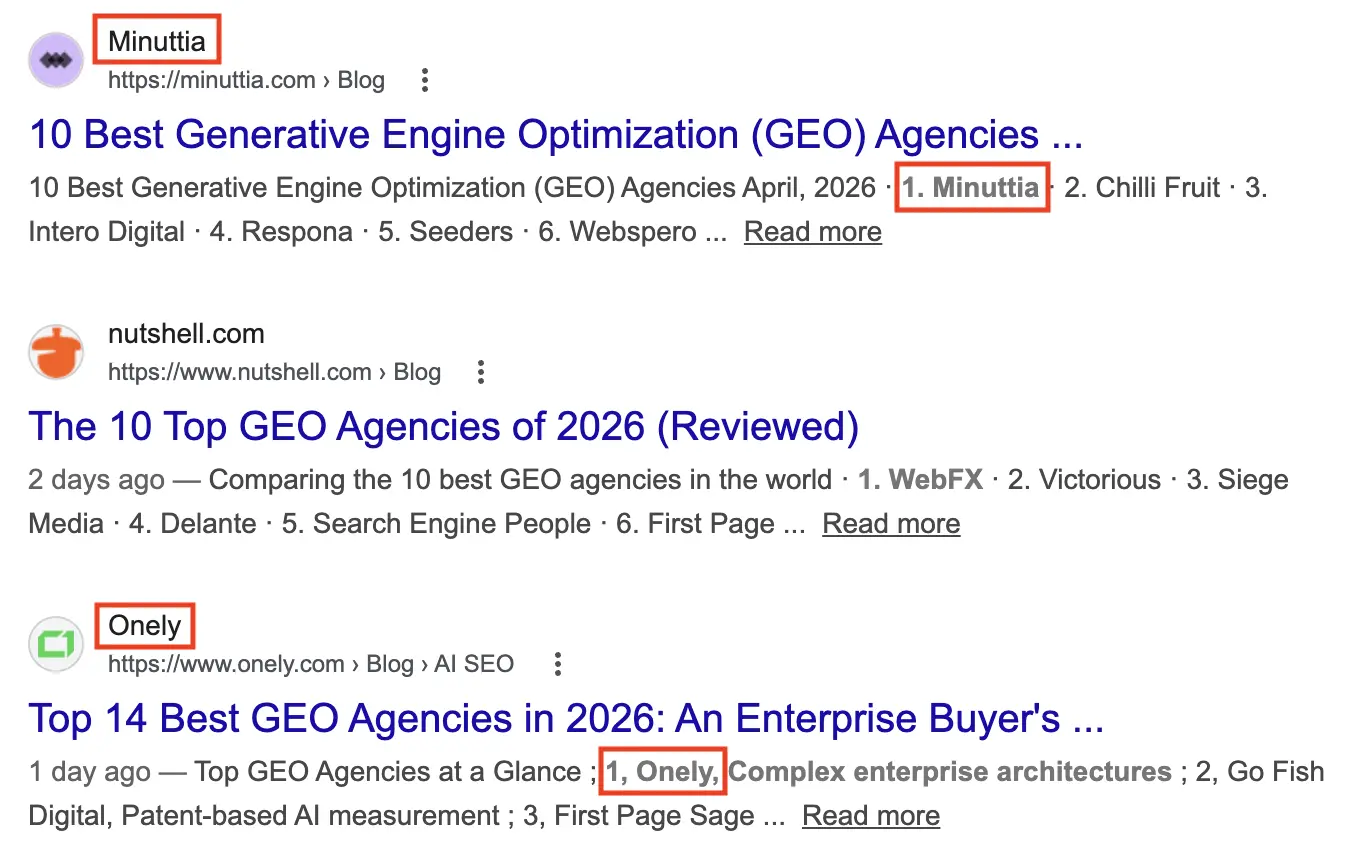
The brands winning today write listicles with real data, transparent methodology, named experts, and first-hand experience behind every item.
In this article, I'll cover 10 rules for writing a listicle that ranks in Google and gets cited by ChatGPT, Google AI Overviews, and Perplexity in 2026.
TL;DR: How to write a listicle that ranks and gets cited in 2026
Target commercial-intent queries where comparison is the user's job (best / vs / alternatives to)
Stay within your topical authority: write listicles in categories where you're a genuine expert
Categorize by use case (best for small teams, best for enterprise) instead of forcing a pure 1–10 ranking
Justify ranking yourself number one or exclude yourself from your the list altogether
Match headings with user queries and year in the title to signal freshness
Use an objective and transparent assessment methodology based on facts, not opinions
Structure content for AI parsing: a comparison table at the top, clear H2-H3, and 120–180 words per section
Write with real first-hand evidence: screenshots, test data, measured metrics, honest limitations. Don't AI-scale.
Quote 5+ named experts and cite 3+ studies, every claim backed by a linked source
Refresh quarterly with substantive updates
Rule 1: Pick the right topic
Not every topic deserves a listicle. The format works best when the user is actively comparing options.
For example, a query like “best crm software for startups” is naturally suited to a listicle. The user wants to compare multiple products. They expect categories, pros and cons, pricing notes, use cases, and a clear recommendation.
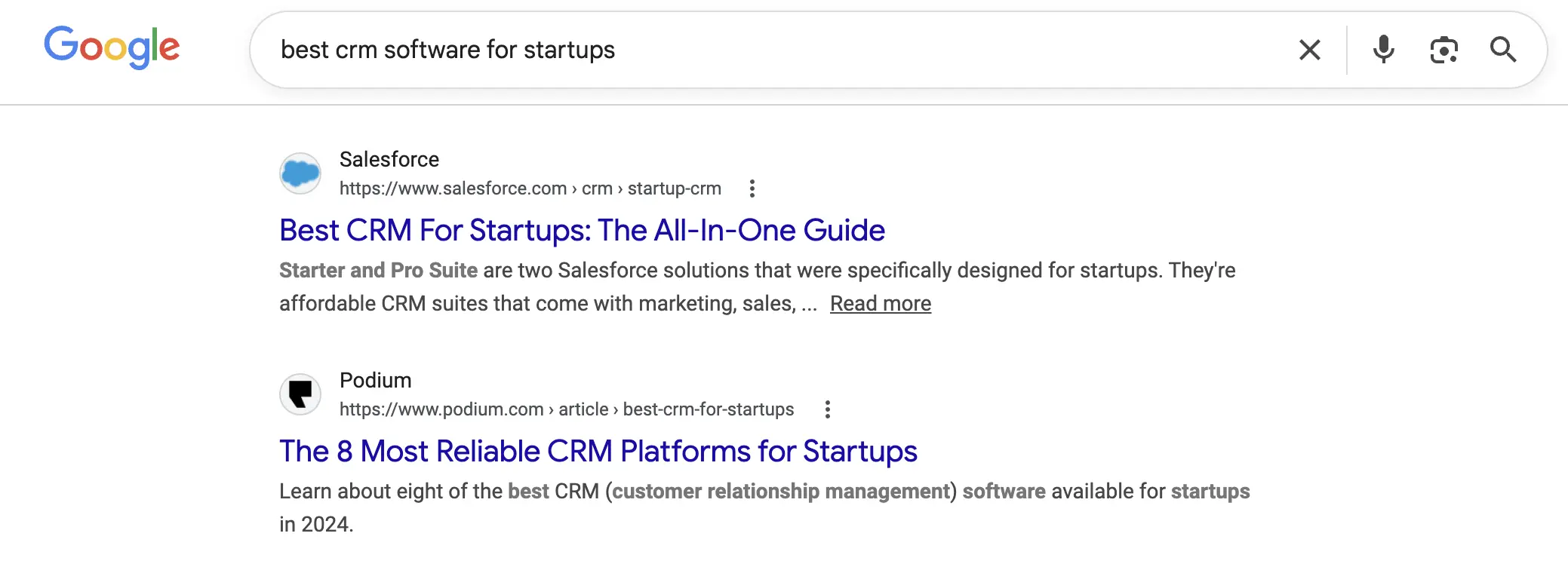
A query like “what is CRM software” is different. That user is still learning the concept. A listicle would feel forced because the search intent is informational, not comparative.
This distinction matters even more in AI search. LLMs are more likely to cite content that directly helps answer a comparison-style query.
According to Wix Studio’s analysis of 75,000 AI answers across ChatGPT, AI Mode, and Perplexity, 40.9% of commercial queries cite citations. For informational queries, articles (45%) are the dominant content type.
Justin Berg, Founder and CEO of Rock The Rankings, shared his thoughts on LinkedIn:
"LLMs heavily weight "best software" roundups when making recommendations. If you're not building lists for: "Best [category] software for [use case]", "Best [category] software for [job to be done]", or "[Competitor] alternatives"...you're not getting recommended."
Practical tips:
Use a keyword research tool like Ahrefs to find keywords that include the term “best,” “top,” and “alternatives.”
Check the top five results for your target keyword. Make sure the SERP is dominated by listicles.
Run the keyword through ChatGPT, Google AI Overviews, Gemini, and Perplexity. If AI answers pull from listicles, you've confirmed the format is cited for that query.
Rule 2: Stay within your topical authority
ClickUp lost 97.6% of its blog traffic not only because they scaled listicle production, but also because they wrote about topics unrelated to their core products, like:
150 Best WhatsApp Status Quotes (97.8% traffic drop)
50+ Wednesday Motivational Quotes for Work (99.4% traffic drop)
The punishment wasn't only for scaling thin listicles. It was for scaling thin listicles in categories Google never associated the domain with in the first place.
Michael Williams put it plainly:
"Google has known who you are since day one. The moment you color outside your lines, you run the risk of Google saying 'Not so fast, this isn't in your wheelhouse.'"
The lesson: only write listicles that are relevant to your core products or services, where you have genuine expertise.
Practical tips:
Run site:yourdomain.com/blog/ intitle:best on your own domain. Flag and remove any listicle that’s outside your category.
Before introducing a new category, establish authority with experience-led content first: product pages, case studies, and original research pieces. Earn the entity association before you try to monetize it with a listicle.
Rule 3: Categorize by use case
AI chatbots have opened up new possibilities for users: they now can ask long, specific questions — something that traditional search engines couldn’t accommodate.
In fact, Semrush found that the average AI Mode query was almost twice the length of a traditional query (7.22 words vs. 4.0 words). ChatGPT prompts are even longer: 23 words on average.
Platform | Average query length | Example |
|---|---|---|
Traditional search | 4 words | Best listicle outreach tools |
AI Mode | 7 words | Best listicle outreach tools for small agencies |
ChatGPT | 23 words | Can you recommend tools that can find listicles that already rank in Google and AI engines? Ideally with outreach capabilities as well |
A generic "10 best SEO tools" listicle might still work for traditional search. AI search demands something more specific — content that answers the exact query the user asked.
That’s why it’s important to organize your list into categories. For example, you can break down “best SEO tools” for different target audiences:
Best SEO tools for agencies
Best SEO tools for startups
Best SEO tools for enterprises
Or different use cases:
Best SEO tools for keyword research
Best SEO tools for technical audits
Best SEO tools for competitor analysis
Categorization also gives you an ethical path to self-inclusion.
If you write "Best CRM for agencies" and you genuinely are the best CRM for agencies, you can rank yourself #1 in that sub-section honestly. You get the #1 spot where you actually deserve it, with no disclosure gymnastics.
Practical tips:
Identify 3–5 honest use cases your audience actually has. Rank 2–4 items per sub-section.
Name each sub-section the way your reader would search: "Best [category] for [use case]".
Only feature your own product in sub-categories where you're genuinely the best fit. If you can't honestly defend the #1 spot, don't take it.
Rule 4: Disclose transparently
Either exclude yourself from your own lists entirely, or disclose the conflict upfront. Never rank yourself #1 overall.
It’s not only bad for your SEO and AI visibility, but it can also be misleading to potential buyers.
Wil Reynolds of Seer Interactive didn't pull his punches:
"Any marketer worth a damn knows listing yourself at the top of a list hosted on your site doesn't build trust with buyers."
Here's my favorite version of the argument, from a senior SEO on r/SEO:
"I worked for a big box retailer who wrote things like 'Top 10 Best Printer Papers', with nine of the ten being their own house brand. I deleted the article from the website. When they asked why, I asked them how that experience would feel to them as a searcher. The room fell silent."
If you decide to include your own product, make sure to be objective. Explain clearly why you’re the best option for a specific category (see rule 3) and give genuine cons for your own product.
Rule 5: Optimize headings for AI
Your title is the first thing AI engines parse when deciding whether to cite you. Get it wrong and the rest of the listicle never gets read.
Three factors matter more than any others: semantic relevance, list length, and freshness signal.
Match user queries
Pages with a semantically relevant title are more likely to get cited by ChatGPT.
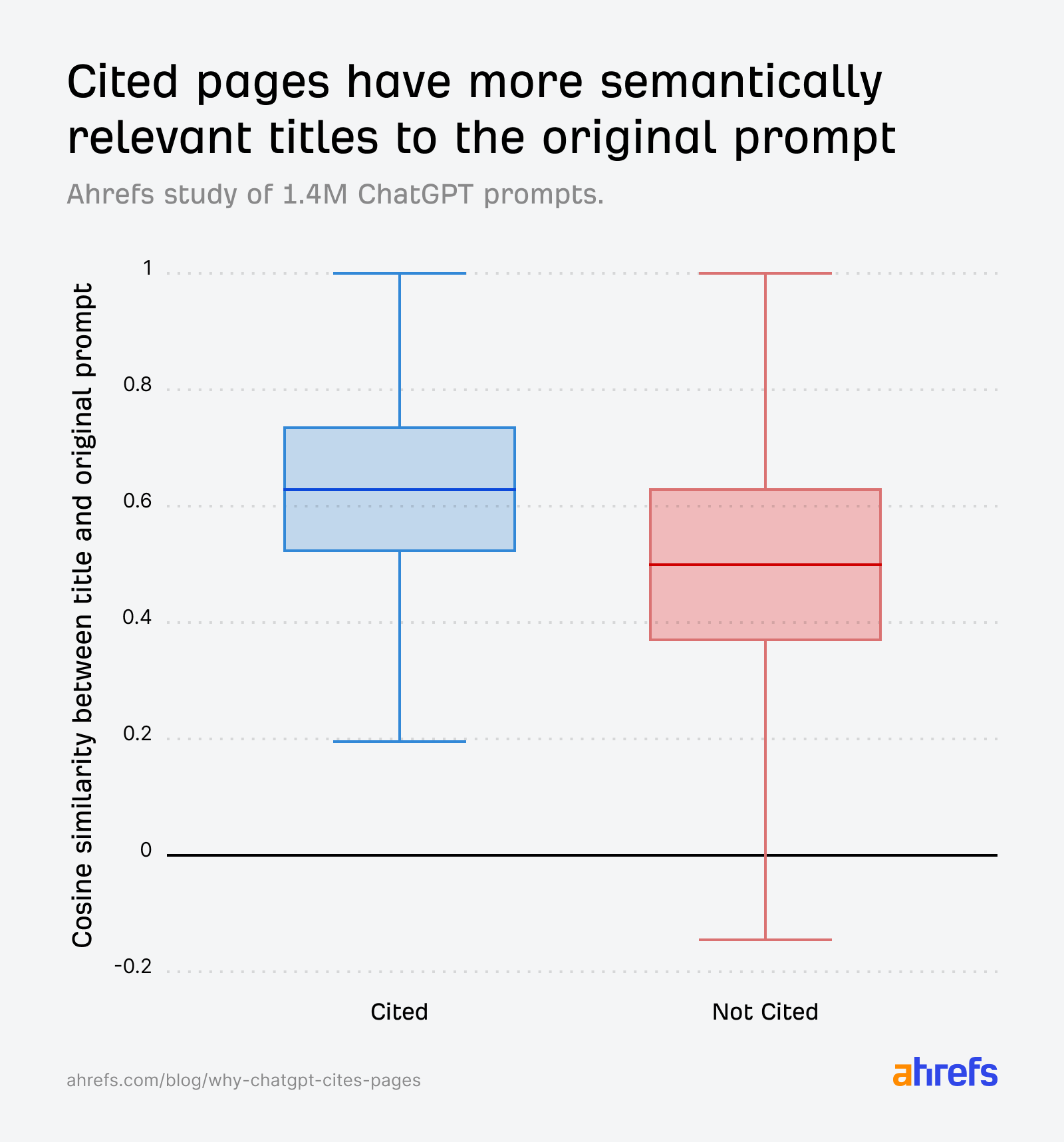
That doesn't mean keyword-stuffing — it means writing a headline that matches how the reader actually phrases the question.
If the query is "best CRM for agencies," the title should include those exact words in that order. Not "The ultimate guide to choosing CRM software for agency teams in the modern era."
Use odd numbers in the title
Gilad Lotan's analysis of 10,000 BuzzFeed listicles found that headings with odd numbers outperform those with even numbers.
So, instead of “10 best CRM software,” use 9 or 11. However, don’t force it. A solid 10-item list is better than a padded 11-item list.
Caveat: Lotan's study predates AI search, so apply the finding with judgment.
Add year in the title
Adding year signals freshness, which is a major ranking factor in AI search. SE Ranking found that content updated within the past three months averages nearly double the citations in ChatGPT (6.0 vs. 3.6).
Maeva Cifuentes analyzed 16,346 AI citations across three B2B brands. Her conclusion was clear: putting the year in your title correlates with a 28% lift in AI visibility.
Nick from Profound explained the mechanism:
"20–30% of the time ChatGPT appends the current year to the search it passes to SerpAPI. If you have the year in your title and H1, you have that much better of a chance of being cited."
Rule 6: Use objective assessment criteria
Write a dedicated methodology block near the top of the article. Say who tested, how long, what criteria you used, and how you scored.
The more objective the assessment criteria is, the better. This is because LLMs love citing factual information:
Pages with 19 or more stats earn 5.4 citations on average versus 2.8 for pages with minimal data. (SE Ranking)
The typical cited article in AI Overview covers 62% more facts than the typical non-cited one. (Surfer SEO)
Include facts, not just opinions:
Awards and recognition. Industry awards, G2 leader badges, Gartner inclusions, Forrester Waves. Third-party validation carries more weight in AI citation than your own ranking does.
Real numbers. Customer ratings (G2, Capterra, TrustRadius), user counts, case study metrics, pricing tiers, integration counts. Numbers are the single highest-density signal an AI engine can extract from a passage.
Case study evidence. Add specific, named outcomes from real customers, such as "reduced onboarding time by 40% for Acme Corp." Link to the full case study where possible.
First-hand test results. If you measured something yourself — load times, onboarding duration, export speeds — name the number and the method.
Digital Web Solutions nailed the last rule:
"A page that says 'based on our analysis of X campaigns, we found...' is citable. That specificity is what transforms content from something AI reads to something AI quotes."
Practical tips:
Put the methodology block inside the first 200 words of the article.
Cover four things: who tested, how long, what criteria, how you scored.
State your own background so readers understand why your judgment matters.
Use objective and measurable criteria, not subjective opinions.
Rule 7: Structure your content for easy parsing
Every item in your listicle should follow the same structure. This sounds basic, but it makes the content easier for AI engines to parse.
ChatGPT, Google AI Overviews, Gemini, and Perplexity are looking for clean, extractable information.
If every item follows the same pattern, it is easier for an LLM to understand what each company does, who it is best for, what makes it credible, and where its limitations are.
A senior SEO on r/SEO_LLM described the mechanism:
"Listicles are token-efficient, entity-dense, and structurally aligned with how knowledge graphs represent relationships. Each item is basically pre-chunked for RAG extraction."
Here’s what you need to include in your content:
A comparison table at the top of the page. Summary blocks make content 49% more likely to appear in AI answers. (AirOps)
Sequential heading hierarchy. Clear and properly ordered H2-H4 tags increase citation odds by 2.8x. (AirOps)
Concise descriptions. Explain each item in a comprehensive but concise manner. Sections with 120–180 words earn 70% more citations than shorter ones. (SE Ranking)
Images or screenshots. Content that includes text, images, and structured data shows 156% higher selection rates vs. text-only in AI Overviews. (Wellows)
For each item, follow this template:
H2 or H3 with the item name
A screenshot of the product
Direct answer in the first 40 words of the item
Best for: one specific use case/audience
Pricing with a link to the actual source
Features as concrete, filterable attributes
Pros and cons, genuine and specific
Bottom line in one sentence
Rule 8: Write from first-hand experience
Every site in Lily Ray's analysis came back 100% AI-generated when she spot-checked articles in Originality.ai. That isn't a coincidence.
In a world filled with AI slop, the only way to stand out is to do what AI can't: try the products yourself and share what you found.
A practitioner on r/seogaps described how he creates performing listicles:
"I test the product, collect screenshots, note limitations, and highlight who shouldn't use it. That honesty builds trust. Strong listicles still work, they just need to feel earned."
Practical tips:
Take screenshots from your own account, with the cursor or account name visible.
Record measured metrics you actually hit, not manufacturer claims.
Use first-person opinion: "I ranked this third because..."
Rule 9: Quote named experts
If you can’t share first-hand experience, another way to boost credibility is to include opinions of actual experts.
According to Wellows, including expert quotes with credentials can increase AI visibility by 78%. SE Ranking confirms this finding: pages with expert quotes earn 4.1 citations on average versus 2.4 for pages without them.
Practical tips:
Source quotes from LinkedIn posts, conference talks, podcast transcripts and journalist tools like MentionMatch.
Full attribution on every quote: name + LinkedIn link + title + company + company link.
Rule 10: Refresh regularly
AirOps' 2026 research shows pages not updated quarterly are 3x more likely to lose AI citations. 83% of commercial citations come from pages updated within the last year. Fresh content is table stakes.
What you can't do is fake the refresh. Lily Ray's analysis explicitly flagged "2026" titles with no substantive updates as a red flag. That's exactly what got punished in January. Digital Web Solutions captured the rule in one line:
"Treat every refresh as a miniature republication. Before touching existing content, ask what has actually changed."
Practical tips:
Refresh at least every quarter. Monthly is better if your category moves fast.
A substantive refresh means new data, revised conclusions, added or removed tools, or updated pricing. A year-swap alone isn't a refresh.
Document what changed in the intro or sidebar so the update is visible to readers and crawlers.
For the complete steps, check out my content refresh guide.
Earn placements on third-party lists
Writing your own listicles comes with certain risks. Publish too many of them, and you can be punished for spam like ClickUp. Rank yourself #1 too aggressively, and you erode buyer trust.
A better and safer method is to feature your brand in listicles that already rank in Google and AI answers:
Brands are 6.5x more likely to be cited through third-party sources than their own domains. (AirOps)
Nearly 90% of brand mentions in AI answers came from listicles, comparisons, or reviews. (AirOps)
97.8% of citations come from content you don't own. Your website barely registers. AI surfaces what other people say about you. (Maeva Cifuentes)
Here’s how:
Step 1: Find the listicles you should be in
Find the top 10 listicles for every commercial keyword you care about, check which are cited by AI, and flag the ones that don't mention you.
ListBrew is the tool I built to handle this process end to end. It scans Google for every commercial query you care about, checks which results are cited by ChatGPT, Google AI Overview, Gemini, and Perplexity, and flags where your brand is missing.
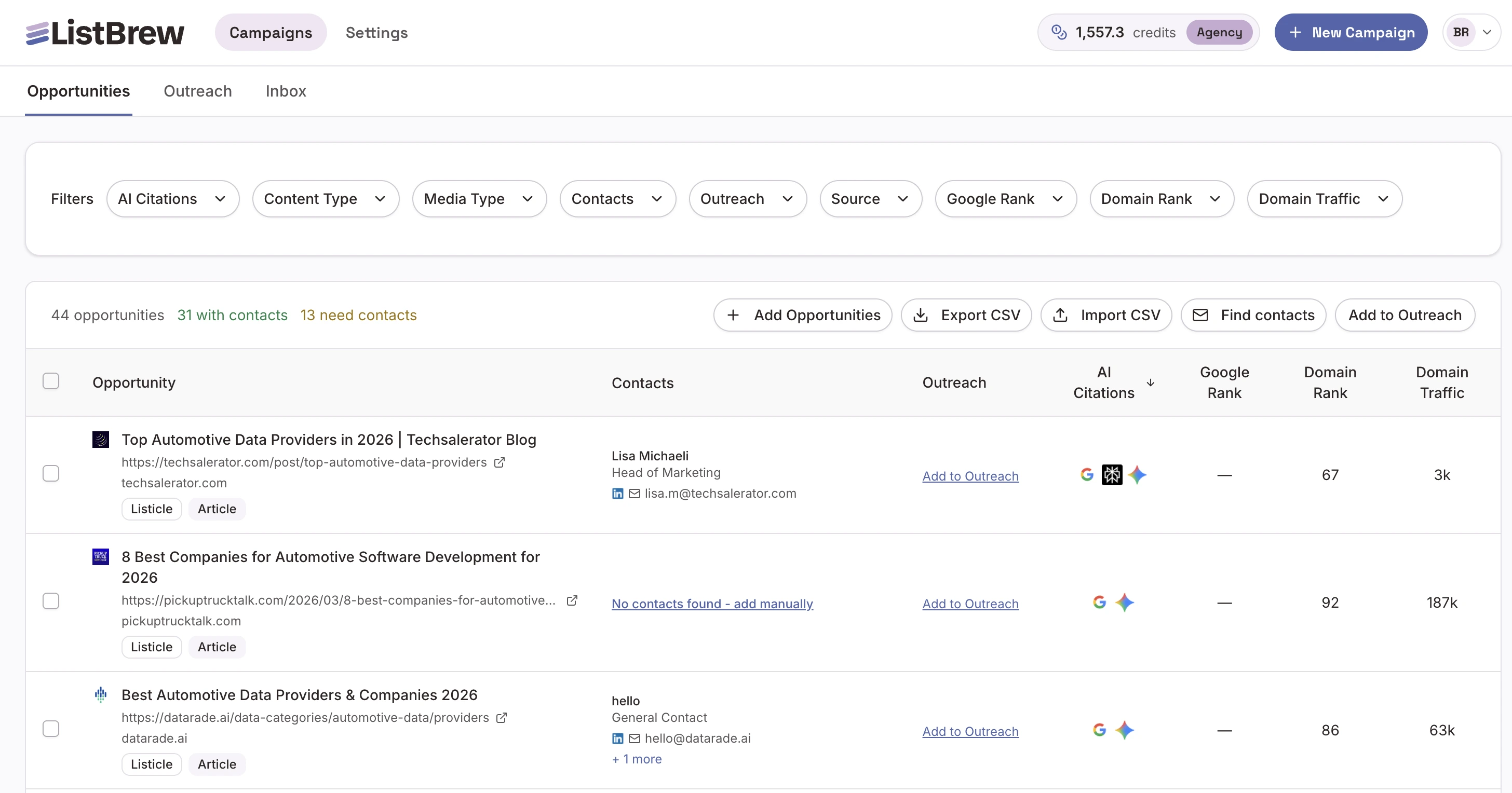
An audit that would take an afternoon to do manually, runs in about five minutes with ListBrew.
Step 2: Find the contact details of each listicle
Most listicles are bylined — start with the author's name on the article itself. Search their name on LinkedIn to confirm their current role and company. Then, use Hunter.io or Apollo to find their work email in seconds.
If the article has no byline, check the publication's "Team" or "About" page for the editor responsible for that content category.
You can also use the “Find contacts” feature in Listbrew to save time. It pulls editor contact details through Hunter and Apollo, which saves hours of manual research.
Step 3: Pitch your brand to be included in the listicles
Send an email or a LinkedIn message to the author or editor of each listicle.
Your pitch should include:
Why your brand belongs in the list
Which category or use case you are best suited for
How you compare to the existing options
Evidence that supports your inclusion
Any missing information that would improve the article
What you offer in return (e.g. a link exchange)
If possible, ask for a top 3 spot in the listicle. AirOps found that 80% of brands often appeared as one of the first three companies discussed in the cited content.
But don’t just ask for inclusion. Offer value to make your pitch more interesting.
Irina Maltseva ran a Hunter's listicle outreach campaign and achieved a response rate over 50%. Her rule is simple: no value = no pitch.
In her outreach email, she explained clearly what the benefits the blog author or editor would get after featuring her product:
Automatic inclusion to her affiliate program
She would provide the content for the listicle
A backlink from her upcoming guest post
Ready to get featured on the listicles AI already cites?
ListBrew is a listicle outreach tool that helps you find hundreds of listicle opportunities in minutes.
Here's what you get:
Every listicle that ranks for your target queries, cross-referenced against ChatGPT, Google AI Overview, Gemini, and Perplexity
Editor and writer contact details pulled automatically through Hunter.io and Apollo
Domain authority, traffic, and AI citation recurrence for every result, so you know which lists are worth pitching
Campaign tracking and citation monitoring across every major AI engine
Start free. No credit card. The first campaign usually surfaces hundreds of listicles you should already be featured on.
FAQs
How do you write a good listicle?
Match it to a commercial-intent keyword, stay within your topical authority, use a consistent structure and transparent methodology, write with first-hand experience, and refresh quarterly.
What is a listicle in writing?
A listicle is an article presented as a numbered or bulleted list, typically covering 10–20 items with consistent per-item structure. Fuller definition of a listicle here.
How long should a listicle be?
Target around 2,500 words across 10–20 items at 120–180 words each, per SE Ranking's analysis of 129,000 domains.
Are listicles still a thing?
Yes. Listicles drive 21.9% of all AI citations and 40.9% of commercial-query citations, per Wix Studio's analysis of over a million citations.