Most listicles today are generic, repetitive, and written purely to rank. They recycle the same ideas, provide little real insight, and exist solely to self-promote the product of whoever is writing.
As a result, both Google and LLMs are currently punishing low-quality, AI-generated listicles. ClickUp alone lost an estimated 7 million organic visits after scaling nearly 2,000 listicles optimized for AI.
If you want to rank in Google and get cited by LLMs, your listicle needs to be unique, original, and packed with value.
Not sure where to start? Here are six high-performing listicle ideas that are far more likely to attract traffic, links, shares, and customers.
1. First-hand experience listicle
This is a list structured around something you've personally done, tested, or learned — mistakes you've made, experiments you've run, products you've tried and evaluated firsthand.
Why it works:
Anyone can write a list. But not everyone can write your list. First-hand experience content is the one format that can't be directly replicated — because no competitor has access to the same incidents, decisions, and outcomes you do.
Examples:
5 Lessons I Learned After Scaling My SaaS to $3 Million MRR
I Subscribed to 72 SEO Newsletters. Here Are My 11 Favorites
I Tried 10 AI Visibility Tracking Tools. Here Are My Top 3
2. Expert roundup listicle
If you don’t have any experience in a particular field, you can simply interview people who do.
An expert roundup collects direct quotes, recommendations, or opinions from multiple practitioners — then presents the compiled responses as a list.
Why it works:
This type of content provides the same uniqueness and value as first-hand experience listicles. However, the difference is, instead of your own personal experience, you’re offering multiple perspectives from multiple individuals.
Wellows also found that 67% of AI-cited content includes direct expert quotes.
Examples:
I Asked 12 SEOs To Share Their Favorite SEO Books
13 Recruitment Agencies Share Their Marketing Strategies
The 11 Best Marketing Insights from the Ahrefs Podcast
3. Original research listicle
Instead of aggregating others' data, conduct your own study and present the findings as a list.
Why it works:
Original data is link-worthy. Other publishers cite it, journalists reference it, and it ranks for informational queries because no one else has the same numbers.
It’s also highly cited by LLMs. As Samanyou Garg, CEO of Writesonic, explained on LinkedIn:
AI systems are designed to provide factual information. Content with precise data points is 25–40% more likely to be cited.
Examples:
We Analyzed 1,000 Cold Emails. Here Are the 9 Subject Line Patterns That Got Replies
Top 10 LLM Ranking Factors Based on an Analysis of 10,000 AI Citations
150+ AI SEO Statistics and Trends for 2026
4. Contrarian listicle
Contrarian content challenges conventional wisdom in your industry.
Instead of reinforcing the same best practices over and over again, you build a case — backed by evidence — that the standard advice is wrong, incomplete, or outdated.
Why it works:
Contrarian takes generate debate, shares, and clicks because they create cognitive dissonance. People click to agree, disagree, or find out if you're right.
Examples:
8 "Best Practices" SEOs Need to Stop Following
5 Reasons a Blog Might Be the Worst Content Strategy for Your Business
Is AI Content Bad for SEO? No, and It Never Will Be (7 Reasons)
5. Case study compilation listicle
Analyze your own clients or other brands in your industry to see how they gain success or failure.
Why it works:
Analyzing real businesses (especially your own clients) proves that you’re an expert in your field. Having well-known brands in your listicle is also a great way to invoke curiosity and boost clicks.
Examples:
8 Companies That Grew With No Paid Ads (And Exactly How They Did It)
12 Small Blogs That Outrank Big Media Sites — What They Have in Common
SaaS SEO Case Studies: Success Stories From 8 Software Brands
6. Community-sourced listicle
Crowdsource answers from a community (Reddit, LinkedIn, Slack groups, X) and compile the responses into a list.
Why it works:
It produces authentic, diverse perspectives quickly. It also gives you a reason to engage communities and credit contributors, which drives shares from people who are in the list.
Examples:
We Asked 200 Freelancers: What's the One Tool You'd Never Give Up? Here Are the Top 14 Answers
Reddit's r/marketing Named Their 9 Most Underrated Growth Tactics
Why these listicle formats work
These listicle formats work because they align with what both humans and AI systems are increasingly rewarding: originality, credibility, and information gain.
For years, generic “Top 10 Tips” content performed well simply because it matched search intent. But today, both Google and LLMs are getting better at identifying whether a piece of content actually adds new information.
That’s why the listicles most likely to rank and get cited tend to include:
First-hand experience
Expert opinions
Original data
Real-world examples
Aggregated community insights
In other words: information that isn’t easily duplicated.
This trend is backed by research.
Wellows analyzed AI-cited content across major LLMs and found that pages containing expert quotes, attributed statistics, proprietary research, and unique examples were cited significantly more often than generic informational content.
How to find listicle ideas in your niche
Sometimes, you don’t need to reinvent the wheel. You simply need to identify what’s already working and create something more useful, more original, or more up to date.
Here’s how you can use ListBrew to surface high-performing listicles in your niche:
Sign up for free to ListBrew.
Create a New Campaign.
Follow the steps to set up your campaign.
You’ll be asked to create a new brand profile, enter your target keyword and location, and choose which AI engines you want to attract citations from.
Once done, ListBrew will show you all relevant listicles for your target keyword
Next, filter by listicles that already rank in Google’s top 10 and get cited by one or more LLMs.
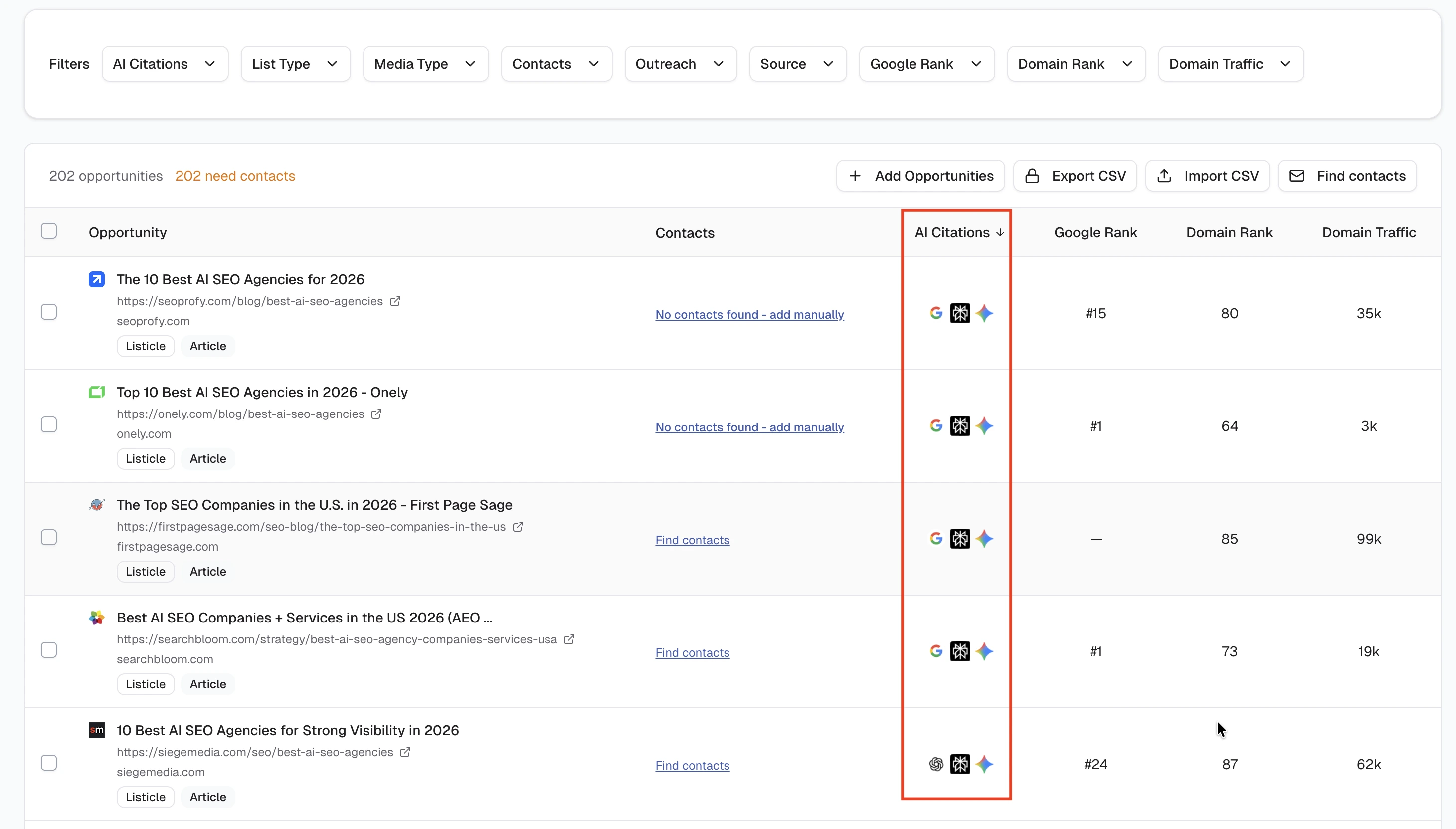
Analyze those listicles to understand what's already working — the topic they target, the format they use, and how many items they include, as well as the gaps you can fill.
Boost your AI visibility with ListBrew today
Finding the right listicle opportunity is only half the job. Getting your brand into the ones that already rank is the other half — and that's where ListBrew's outreach features come in.
Once you've identified high-performing listicles in your niche, you can use ListBrew to contact the publishers behind them and earn a placement directly.
It's the fastest way to build AI visibility without starting from scratch: find what ranks, create something better, and get into the lists your competitors are already in.
Sign up for free and run your first campaign today!