LLMs don't pick a favorite. They answer based on consensus.
The more often a brand appears in the sources AI is pulling information from, the more likely AI will name that brand in the final answer.
So, the only way to increase brand mentions is to appear in citations that are already shaping AI answers.
Here are five quick win tactics to help you do exactly that.
1. Get featured in AI-cited listicles
Our study of ChatGPT ranking factors at Position Digital found that third-party listicle presence is the top factor that drives brand recommendations in ChatGPT answers.
Now, what you need to do is find which third-party listicles are already getting cited by AI engines in your category, and find a way to get featured there.
ListBrew is a tool built exactly for that. Simply sign up for free and create a new campaign — you can choose three different campaign types:
Listicles. Find “best X” listicles like “Top 10 CRM Software” and “7 Best Link Building Tools.”
Product Alternatives. Find alternative roundups like “5 Best Alternatives to Mailchimp” and “10 Free Alternatives to Monday.”
Competitor Comparisons. Find head-to-head comparison pages like “Monday vs. ClickUp: Which is Best for Small Teams.”
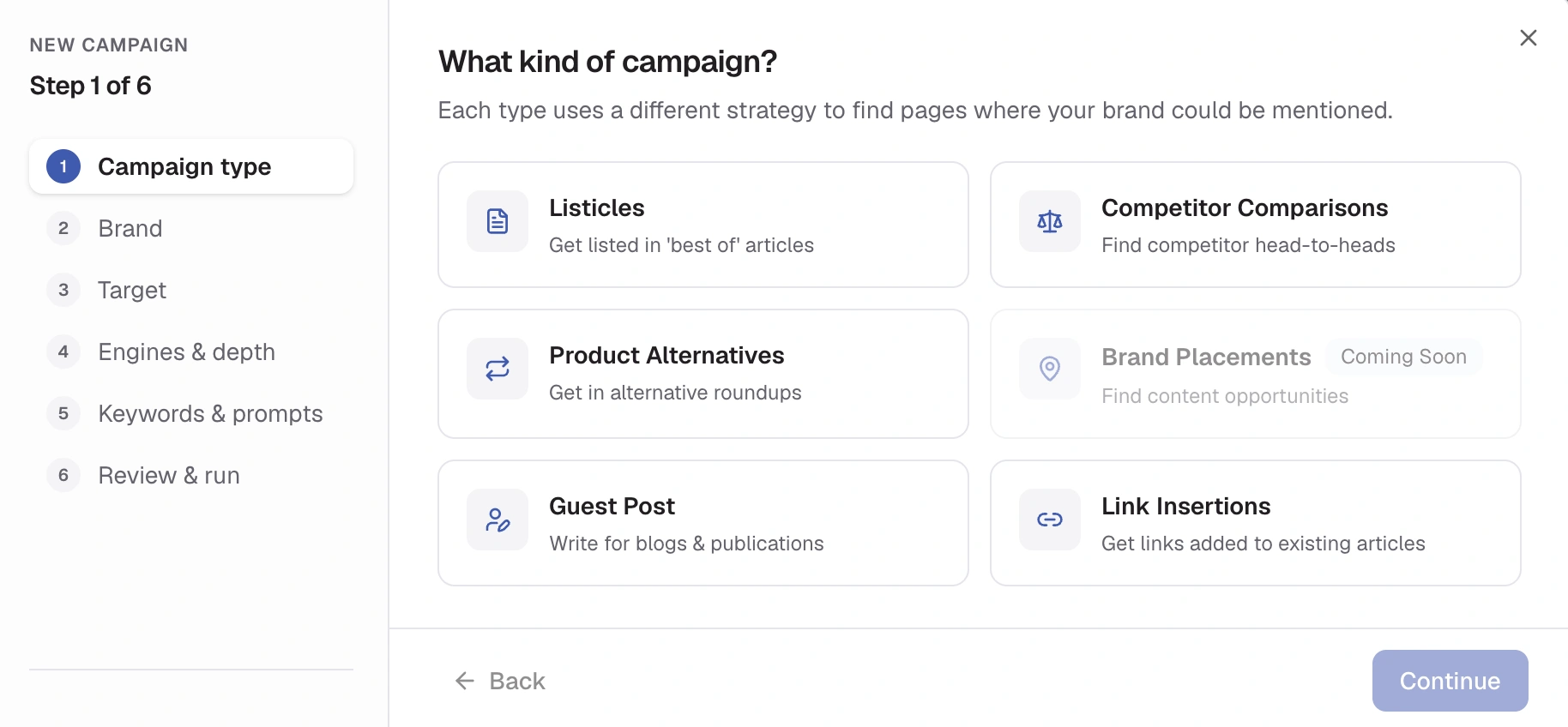
After that, enter your brand details, target queries, and location, and choose which AI engines you want to collect citations from.
ListBrew will then run your queries across Google and selected AI engines, and show you all the relevant listicle opportunities you can target.
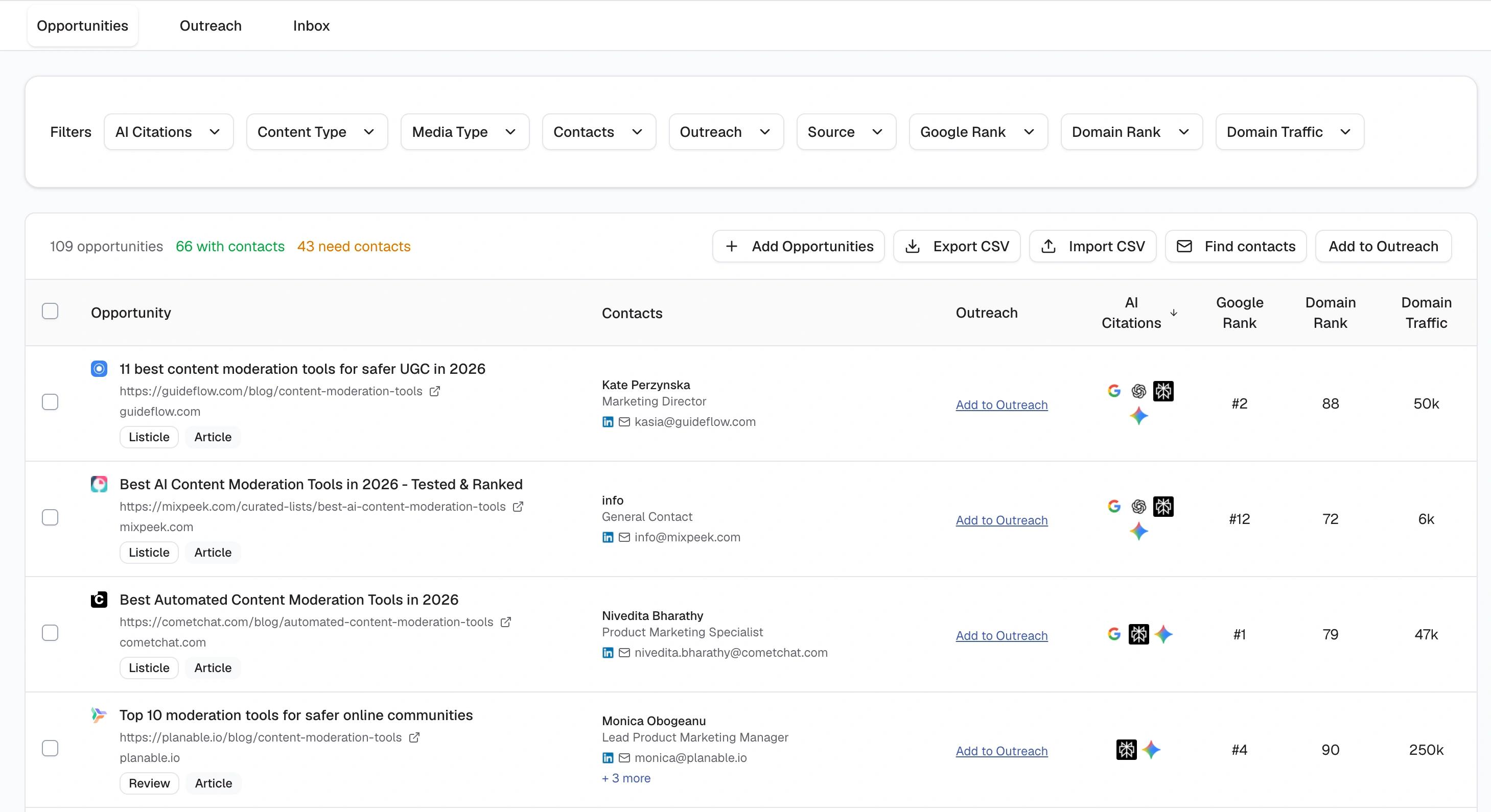
From there, you can filter the result by AI citations to make sure you’re reaching out to the listicles that matter.
Once done, find the contact information for each opportunity and add them to Outreach. Here, you can create outreach sequences, write personalized pitches, and send your outreach emails in one place.
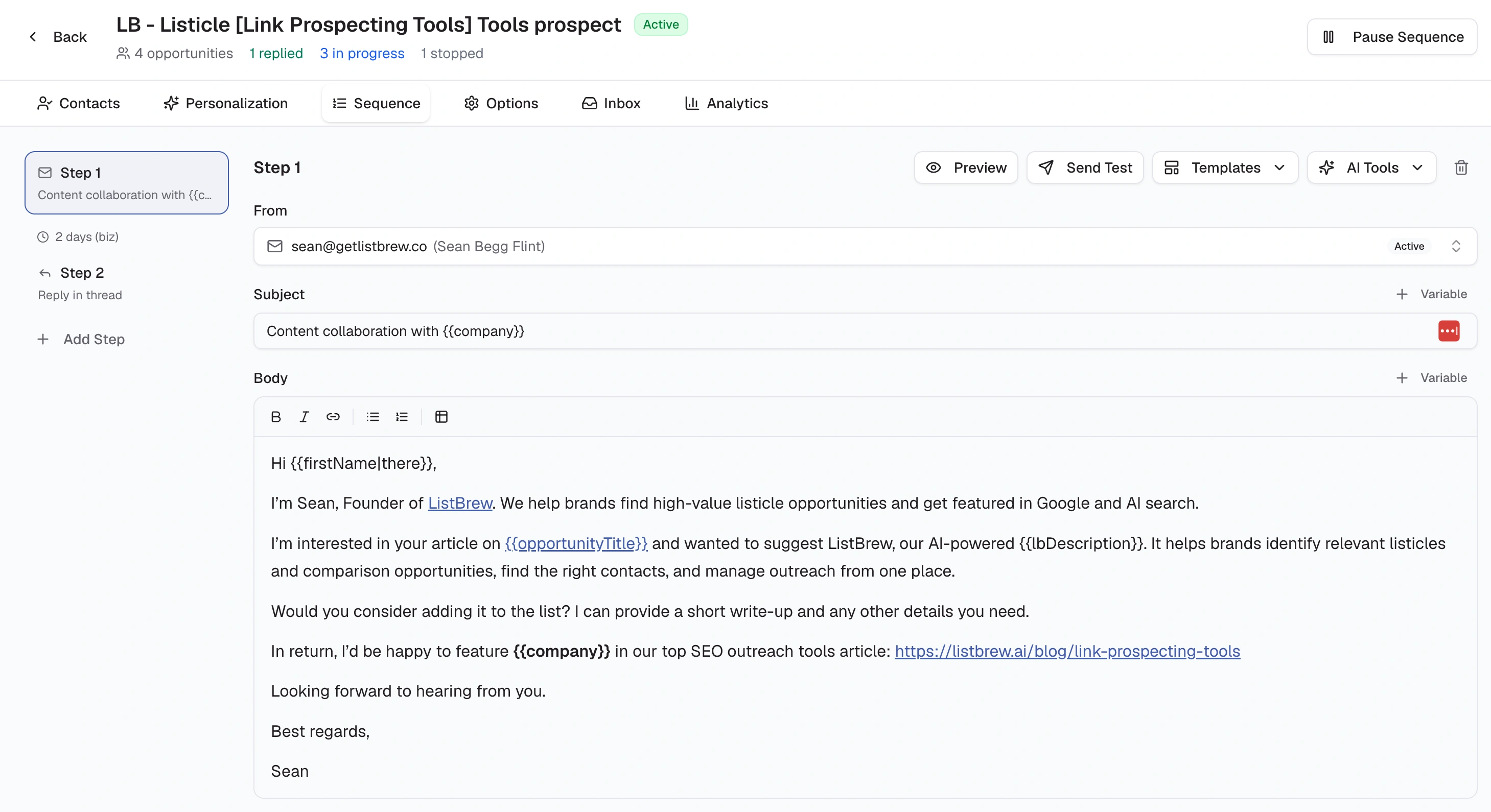
A few tips to increase your reply rate:
Offer a way to genuinely improve the content. Find a gap that your product can fill in and lead your pitch with it. For example: “I noticed that your listicle hasn’t covered a product that can do this; our tool can fill that gap.”
Offer to write the blurb yourself. Make it as easy as possible for the writer or editor to copy and paste the content.
Offer something in return. Maybe a link back from one of your partner sites, a free trial (for SaaS), a shoutout in your newsletter, etc.
2. Conduct link insertion outreach
Beyond listicles, it’s also important to appear in informational content, such as how-to guides, best practices, and “what is” articles that LLMs use as sources.
Again, finding these opportunities is easy with ListBrew. Simply create a new campaign and choose Link Insertions. Then, follow the same steps above to build a list of relevant link insertion candidates.
Before sending your pitch, though, analyze each piece of content to identify how you can genuinely make it more useful:
First-party data. Do you have an interesting finding or statistic from your own research, surveys, or studies that’s relevant to the article?
Proven tactics. Do you have tips or strategies that have worked based on your own experiments, client case studies, or results?
Once you’ve found a genuinely useful contribution, lead with that value in your pitch rather than simply asking for a link.
For example, instead of:
“Could you add a link to our article?”
Try:
“I noticed you mention X in this section, but there isn’t much detail on Y. We recently conducted a study on this topic and found that [insert finding]. Would it be useful to add this finding to the section? We’ve also published the full study here if you’d like to reference it.”
3. Write guest posts on top-cited domains
The first two tactics are about getting featured in existing content that’s already getting cited. This one is about publishing new content on domains with strong AI visibility.
The idea is simple: find websites that LLMs frequently cite for topics in your category, then pitch them a genuinely useful guest post.
Here are the steps:
Step 1: Find guest post opportunities
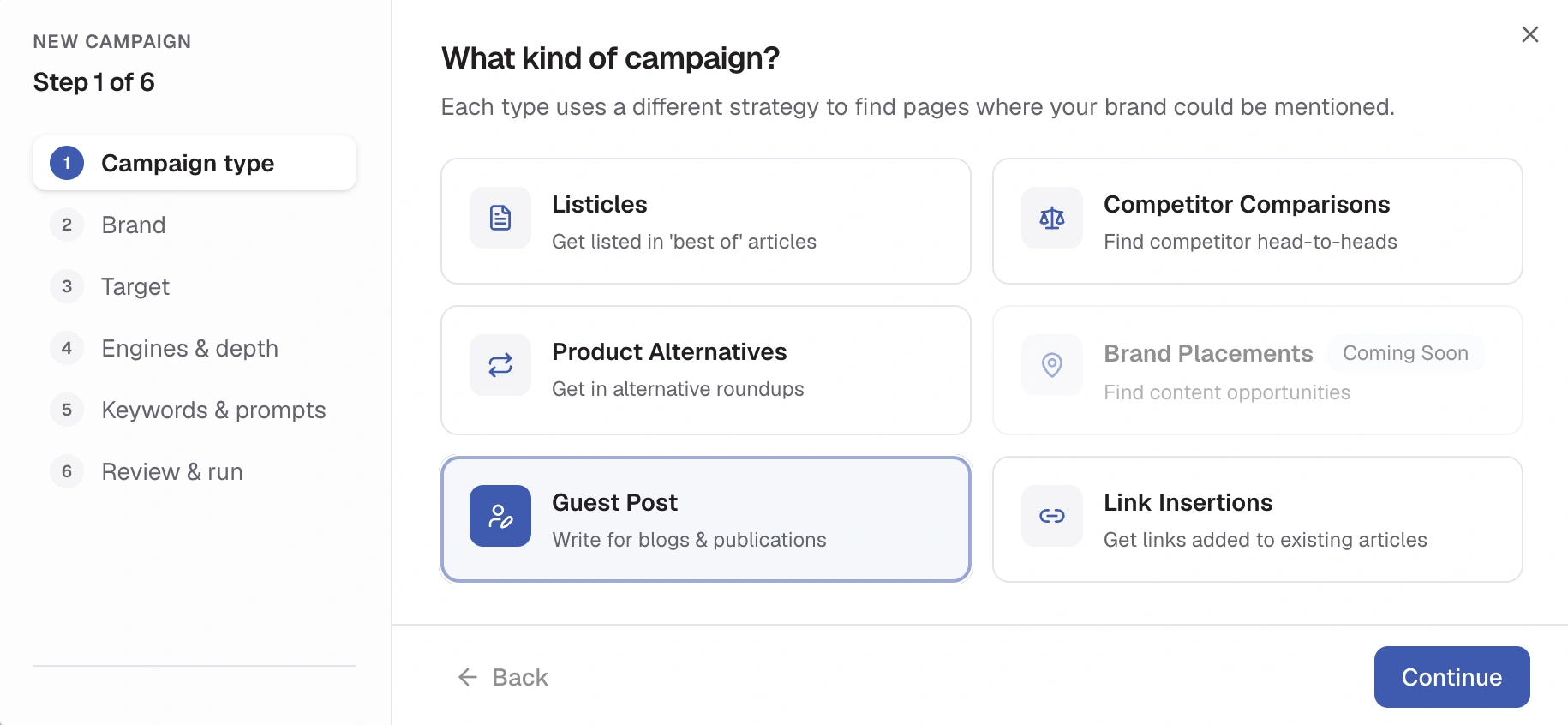
You can use ListBrew to find guest post opportunities:
Create a new campaign.
Pick Guest Post.
Enter your brand details and target queries.
Choose which AI engines to pull citations from.
Let ListBrew do its magic.
Step 2: Brainstorm topic ideas
Once you get a list of relevant domains, come up with several topic ideas for the guest post.
A few tips:
Check what they haven't covered. Search their site for your target topics and see where the gaps are — a subtopic they've never touched, an outdated take, a format (checklist, comparison, framework) they don't have yet.
Match the gap to something you can genuinely speak to. A process you run internally, a mistake you see often in client work, a data point from your own research. The topic should be useful on its own, with or without a mention of your brand.
Shortlist 2-3 topic ideas per domain. Giving an editor options increases the odds one lands, without making the pitch itself longer.
Step 3: Pitch your topics
Send a short but specific pitch:
Lead with one key topic and explain why it fits their audience.
Show you've read their site. Reference a specific post, format, or gap you spotted.
Offer proof you can write. Link to other guest posts you've published before.
Send your pitches via ListBrew and monitor the replies. If your pitch is accepted, proceed to writing the draft. Before you start, read 3-5 of their most recent posts. Note the tone of voice, writing style, angle, depth, and format they publish.
4. Create optimize profiles on review platforms
If you’re building a SaaS brand, this tactic is particularly crucial. Our latest study found that 12% of commercial prompts in SaaS ask specifically for trust signals (“what do users say about X”, “recommend the best X based on reviews”).
When that happens, LLMs go to review platforms like G2 and Capterra.
In fact, a Radix study confirmed that G2 is the most cited software review platform on ChatGPT, Perplexity, and Google’s AI Overviews.
And it’s not just software brands. Seer Interactive analyzed 1,926 brands across 8 industries and found that having an optimized profile on review platforms does impact AI visibility.
Brands with no Trustpilot profile have a median AI citation rate of 1%. Brands with even a minimal profile — as few as 1–13 reviews — jump to 53.5%. That's a 52 percentage point swing.
Here’s how you can build your presence on review platforms.
Step 1: Find the review platforms that matter for your category
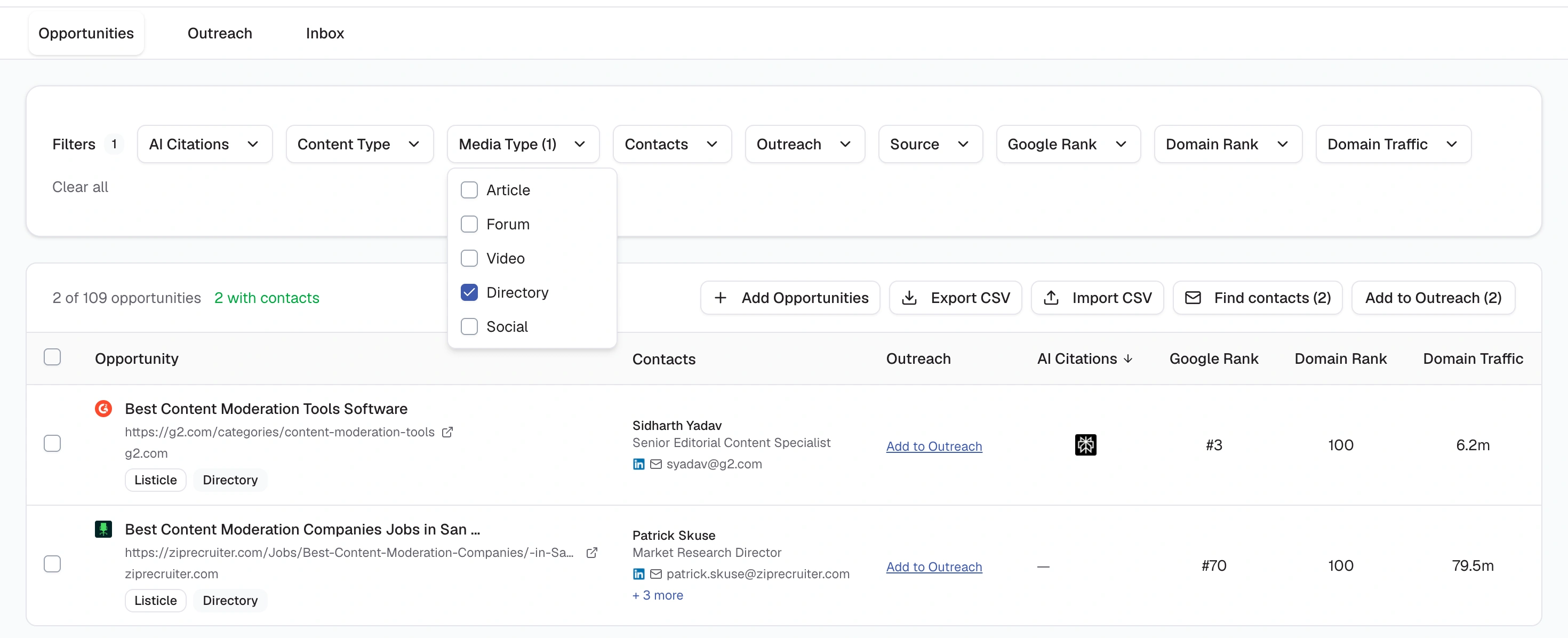
In ListBrew, create a campaign and filter Media Type by Directory. This surfaces the review sites and directories already ranking and getting cited for your target queries.
Step 2: Claim your profile and fill it out properly
Write a clear description of what your product does and who it's for.
Add pricing, key features, and category tags — the details AI pulls directly into comparisons.
Include screenshots or a demo video wherever the platform supports it.
Step 3: Get your first reviews in
Email recent customers directly, with a link straight to the review form.
Time the ask right after a win — after onboarding, a resolved support ticket, or a renewal.
Don't wait for volume. The data shows the jump happens between zero reviews and a handful, not between a handful and a hundred.
5. Partner with YouTube creators
YouTube is the most-cited domain in AI Overviews according to Position Digital's analysis of 321 SaaS citations. It accounts for 14.5% of all citations — more than five times Reddit's share, the next closest domain.
That makes YouTube worth pursuing directly, rather than treating it as an afterthought to your written content.
Step 1: Find the videos AI already cites
Run your target keywords in Google and note which YouTube videos show up in the AI Overview citations.
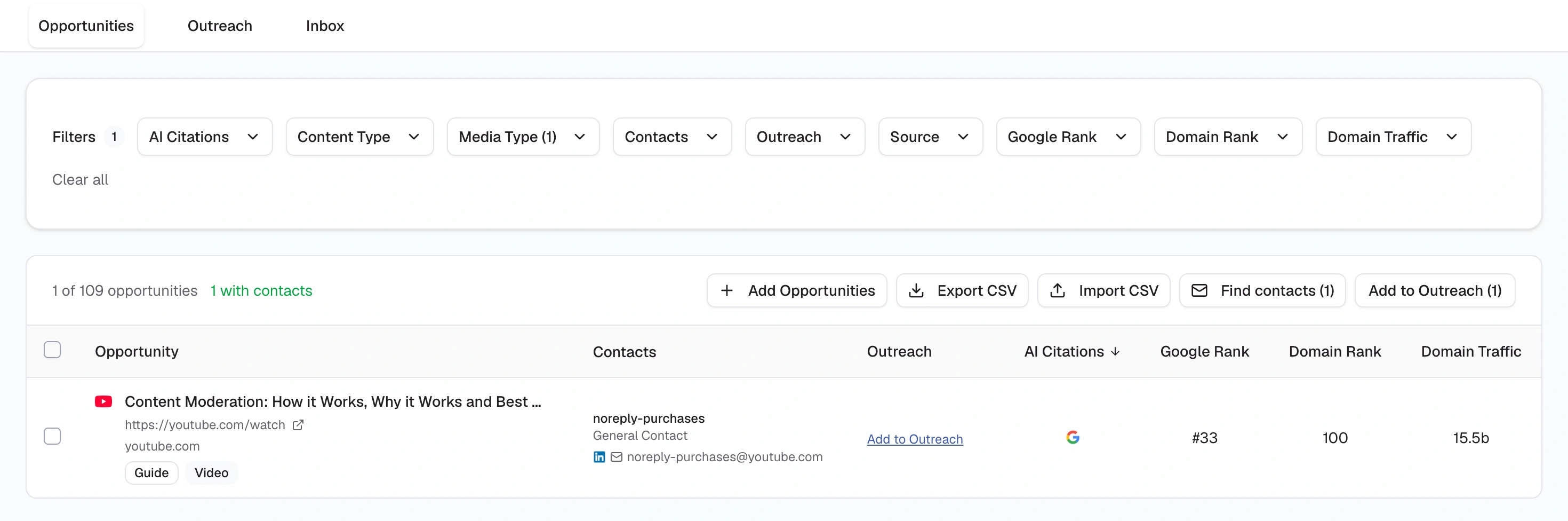
In ListBrew, you can skip the manual searching: filter Media Type by Video inside any campaign, and it'll surface the YouTube videos already ranking and getting cited for your target queries.
Step 2: Find the channel owner's contact information
Most creators list a business email in their channel's About page. You can also pull it through ListBrew's Find Contacts feature, the same way you would for a listicle or guest post opportunity.
Step 3: Pitch the collaboration
A few ways to frame the ask:
Ask them to review your product on camera.
Suggest a head-to-head comparison video against a competitor.
Ask to be included in a future "best of" or "top X tools" roundup — the video equivalent of a listicle placement.
Offer something in return to improve your odds: a free trial for SaaS products, an affiliate commission on conversions, or early access to a feature they can cover first.
6. Contribute to forum discussions
Reddit is the second most-cited domain in AI Overviews — well behind YouTube. And unlike outreach, it doesn't need a pitch or a contact to land. You just need to be part of the conversation already happening.
Step 1: Find relevant threads
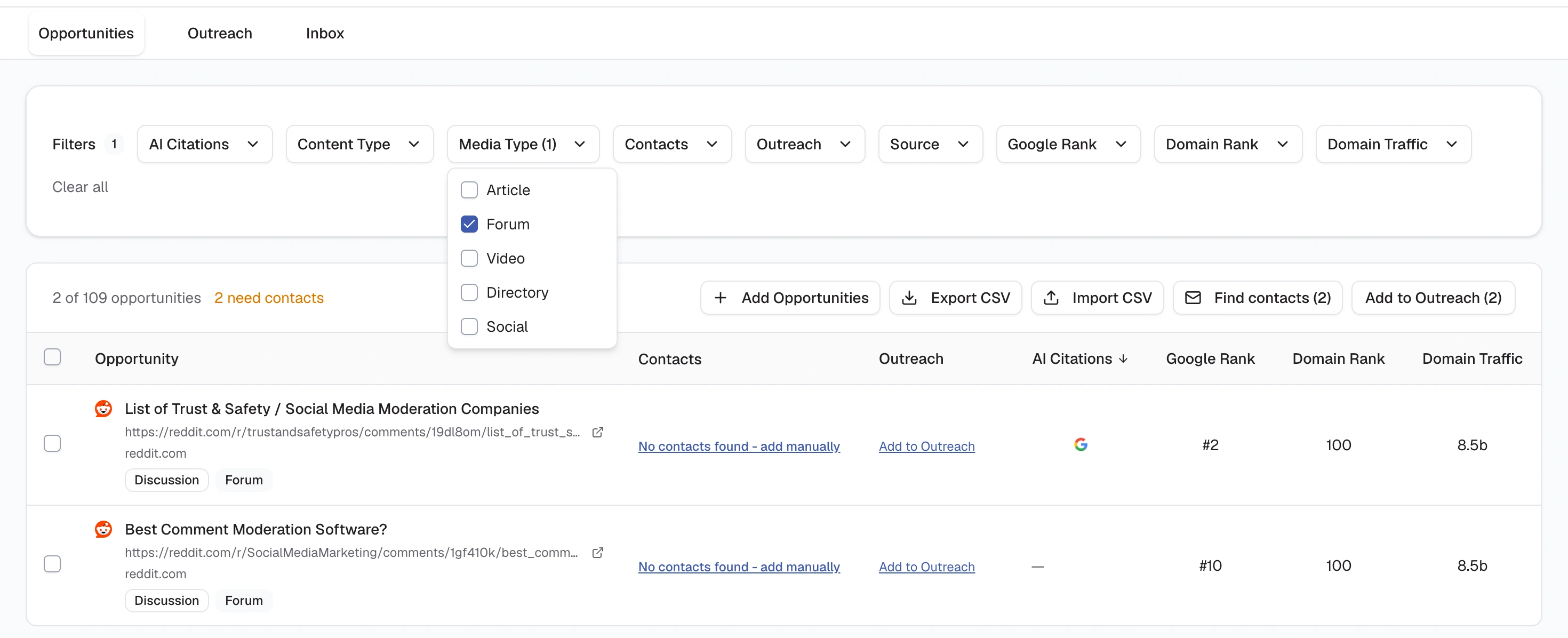
In ListBrew, filter Media Type by Forum. This surfaces the Reddit (and other forum) threads already ranking and getting cited for your target queries, so you're not searching blind.
Step 2: Join the conversation
Answer the actual question first. A comment that reads like an ad gets downvoted and buried before an AI ever sees it.
Mention your product only when it's genuinely the answer to what someone asked, and disclose that you work for or built it — undisclosed self-promotion gets threads (and accounts) removed.
Build a real account history before you start posting about your product. A brand-new account with nothing but product mentions is an easy pattern for moderators and AI systems alike to filter out.
Don't limit yourself to new threads. Older threads that still rank can pick up a well-placed comment and keep surfacing it in AI answers long after the original post.
This one moves faster than the others — a genuinely useful comment on an active thread can get picked up by AI citations within weeks, not the months a guest post or listicle placement usually takes.
The tradeoff is it doesn't scale the same way: this is a channel to stay active in, not a campaign you run once and move on from.
Build your presence in the sources shaping AI answers
Getting mentioned in AI answers is about becoming visible in the sources they already trust and cite.
That means finding the listicles, informational articles, guest posts, review sites, videos, and forums that show up for your target queries — then finding a genuine reason for those sources to mention your brand.
This is where ListBrew can help. It enables you to uncover the domains already appearing in AI citations for your category, find the right contacts, run outreach campaigns, and track your opportunities from one place.
Ready to find the sources shaping AI answers in your category? Try ListBrew for free today — no credit card required.