There are tons of AI visibility tracking tools out there, and I know how difficult it is to find the right one for your needs.
As someone who’s been knee deep in the GEO field for the past few years, I’ve tested and used dozens of these platforms.
Most of them offer pretty much the same thing. But there are exceptions to the rule, and those are the tools worth your time. Below, I’ve pulled together the ones that genuinely earn their place.
The best AI visibility tracking tools at a glance
Tool | Best for | Key features | Starting price |
|---|---|---|---|
OpenLens | Agencies managing AI visibility across many clients | Topic-grouped prompt tracking, GEO audit (AI indexing, site and agent readiness), AI content optimization, in-app agent (Iris) | Free; paid plans start from $39.99 per month |
Ahrefs Brand Radar | SEO teams already paying for Ahrefs | Retroactive brand lookup, search-demand-backed prompt index, competitor gap analysis, source tracking | Starts from $199 per month per AI platform |
Profound | Enterprise teams wanting to attribute GEO success | Agent Analytics (crawler tracking), conversation-based demand data, GA4 conversion link, no-code content Agents | Starts from $99 per month |
Scrunch AI | Enterprise teams preparing for the agentic web | Agent Experience Platform (AXP), AI agent traffic analysis, cross-platform tracking, SOC 2 + SSO | Starts from $250 per month |
Honeyb | Financial institutions and B2B brands wanting to know what AI says about them | AI visibility tracking across 8 major answer engines, sentiment analysis, citation tracking | Starts from $29 per month |
Temso | Agencies selling and delivering AI search to clients under their own brand | AI visibility snapshots for prospects, technical audits, AI bot traffic analysis, white-label client reporting | Starts from $10 per month |
AI SEO Tracker | Founders and small teams who want a one-time AI visibility audit before a subscription | Five-engine audit, prompts written from your URL, competitor gaps, cited sources, action plan, MCP | $49 one time; tracking from $79 per month |
ZeroRank AI | Marketing teams and agencies that want to turn AI visibility data into optimization work | AI visibility tracking and optimization in one platform, built-in Copilot assistant for data analysis | Starts from $39 per month |
OpenLens
- Best for
- SEO and GEO agencies managing AI visibility across a large roster of clients
- LLMs supported
- ChatGPT, Claude, Gemini, Google AI, Perplexity, Grok, and DeepSeek
- Pricing
- Free plan ($0, no card required); Starter from $39.99/mo; Agency from $299.99/mo; Enterprise custom
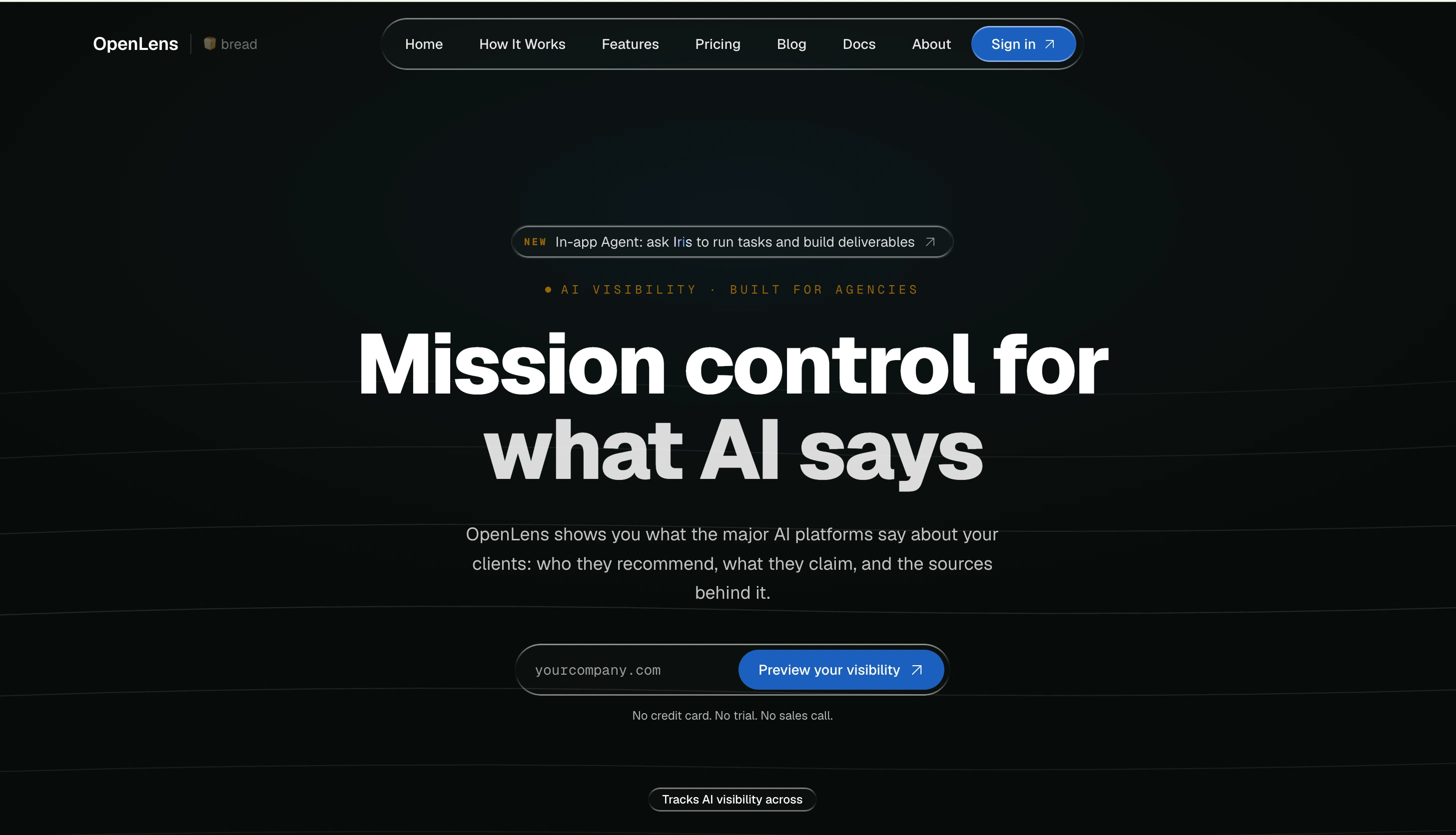
OpenLens is the only tool in this list built specifically for agencies rather than a single-brand tracker with multi-client features bolted on afterwards.
Its defining idea is pricing: you pay per editor seat, never per client, so adding a client is adding a project inside an existing seat rather than another line on the bill.
That structure is what makes including AI visibility inside a modest retainer financially workable, where per-brand tools quickly stop adding up. Built by AI researchers, it tracks seven platforms and gives every client a free, live, read-only dashboard.
What you can do with OpenLens
Group prompts by topic. This allows you to see which topics you’re already visible, and which ones need work.
Monitor brand visibility over time. You can automatically run prompts daily, weekly, or monthly (depending on your plan) across the chosen AI platforms. Each run will reveal your brand’s visibility score, share of voice, average position, and total mentions.
Conduct a GEO audit. Run three readiness checks on any site: AI Indexing tells you whether AI platforms can actually find and cite a project's pages; Site Readiness scores how discoverable the site is to AI crawlers and agents and flags the technical fixes that help; and Content Audit scans your pages for gaps, weak structure, or thin coverage that is holding citations back.
Optimize content for AI search. Turn those audit findings into specific on-page fixes, so you are not just told a page underperforms but shown what to strengthen to earn mentions.
Ask the in-app agent (Iris). Open Iris from any project and ask in plain language, for example "give me a visibility report for X client", to run tasks and build deliverables without digging through the dashboard yourself.
Find the sources AI cites. Source Intelligence surfaces the exact URLs, not just domains, that models reference across the industries you track, which feeds straight into content briefs and digital PR target lists.
Plug it into your own stack. Every feature is reachable through the API and MCP, so visibility data can flow into your existing reporting or agent workflows.
Drawbacks
It’s a new product launched in 2026, so it has a shorter track record than the more established tools
Not suitable for a single brand tracking only one site
Ahrefs Brand Radar
- Best for
- SEO teams already paying for Ahrefs who want AI visibility beside their existing SEO data
- LLMs supported
- ChatGPT, Perplexity, Gemini, Copilot, AI Overviews, AI Mode (Claude via custom prompts only)
- Pricing
- $199/month per AI platform, or $699/month for all AI platforms
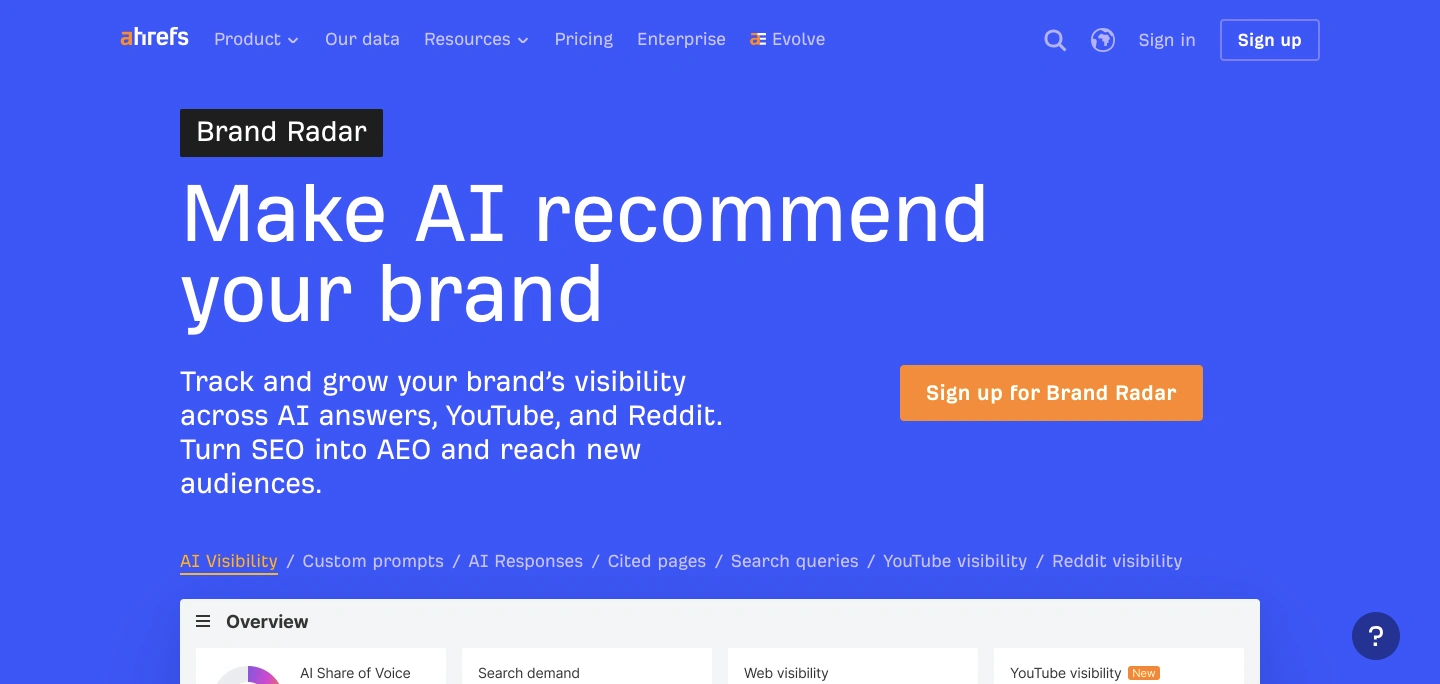
Brand Radar tracks AI visibility in a fundamentally different way from other AI visibility trackers, and that method is its whole differentiator.
Rather than running only the prompts you set up, Ahrefs maintains a vast standing index: it extracts question prompts from its keyword database, seeded from real Google search demand and People Also Ask data and expanded with query fan-out.
You are reading from a pre-built database of past runs rather than commissioning your own, and it all sits inside the Ahrefs interface your SEO team may already live in.
What you can do with Ahrefs Brand Radar
Look up any brand instantly. Because Brand Radar reads from a standing index rather than prompts you configure, you can search any brand, competitor, or domain and see its AI visibility with history and no tracking setup.
Measure against real search demand. Prompts are drawn from Ahrefs' keyword database and People Also Ask data, so visibility is scored against questions people genuinely ask rather than a synthetic list you invented.
Find competitor gaps. An "Others only" filter surfaces prompts where competitors are named but you are not, giving you a concrete list of topics to target with content.
See the sources behind answers. Identify which domains and pages the AI platforms cite when they respond, so you know where mentions and links are coming from.
Keep it beside your SEO data. Brand Radar lives in the Ahrefs interface next to your keyword, backlink, and traffic tools, so there is no separate platform to learn or log in to.
Drawbacks
Measurement only, with no content optimisation or readiness auditing to act on what it finds
Chatbot indexes refresh monthly unless you pay for custom prompt checks, and Claude is covered only via those custom prompts
Profound
- Best for
- Enterprise teams that want AI visibility measured down to crawler behavior and real conversation demand
- LLMs supported
- ChatGPT, AI Mode, AI Overviews, Gemini, Claude, Copilot, Perplexity, Grok, Meta AI, DeepSeek
- Pricing
- Starter costs $99/month and Growth costs $399/mo, plus a custom enterprise plan
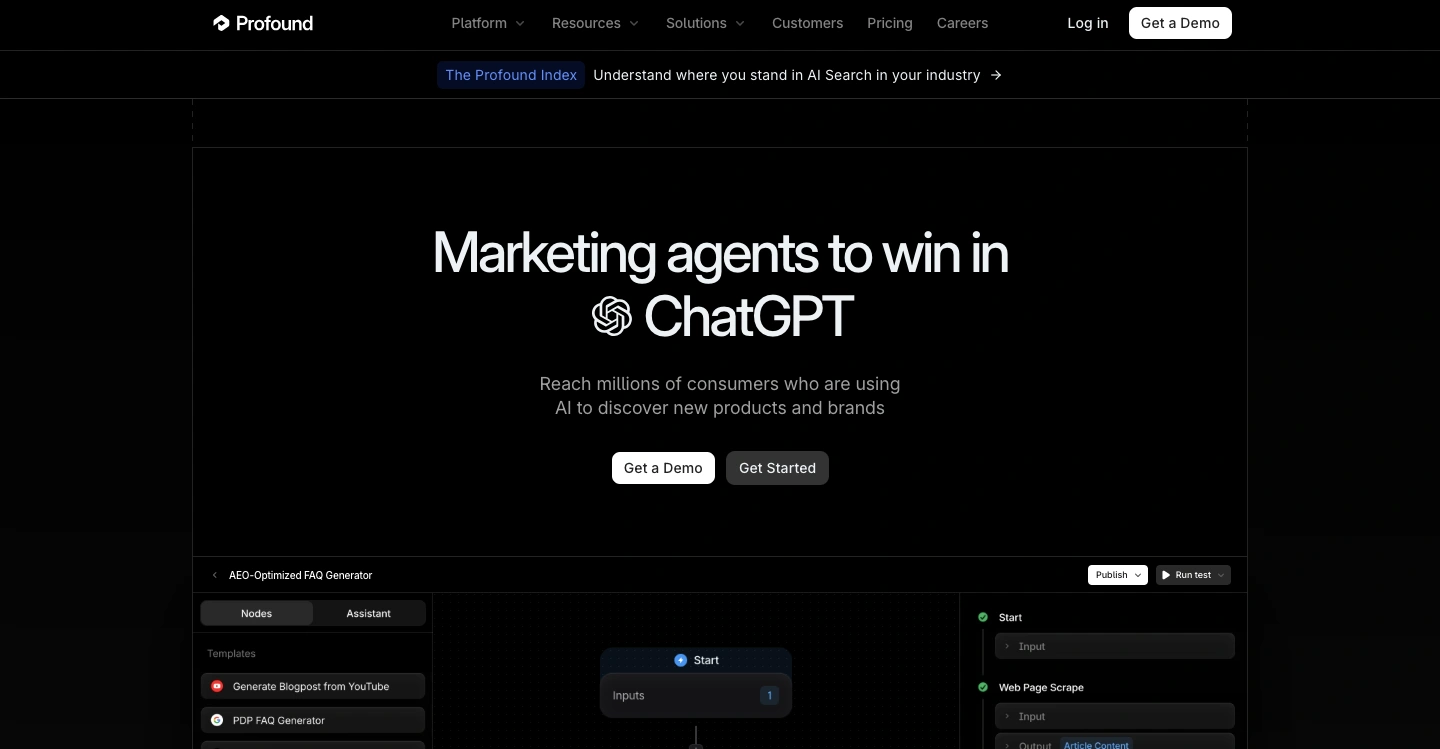
Profound is the enterprise heavyweight of the category, and its edge is the depth of data beneath it.
Rather than relying only on the prompts you configure, it draws on large-scale opt-in clickstream and conversation data, so it measures visibility against the questions people genuinely put to AI rather than a synthetic prompt list a marketer thought to add.
Layered on top is Agent Analytics, which tracks visibility at the infrastructure level: which AI crawlers hit which pages, how often they return, and whether that activity connects through to citations and referral traffic via a GA4 link. That crawl-to-citation-to-conversion chain is the closest anything here gets to genuine attribution.
What you can do with Profound
Track visibility across the major platforms. Run prompts across the AI engines and see mention rate, position, sentiment, and the sources cited, the baseline tracking every tool here offers.
Measure real conversation demand. Prompt Volumes draws on clickstream and conversation panels to show how often topics are actually discussed across AI platforms, a demand signal most tools simply cannot see.
Monitor AI crawlers on your site. Agent Analytics shows which bots (GPTBot, ClaudeBot, PerplexityBot, and others) access which pages and how often, at the infrastructure level rather than the answer level.
Connect visibility to conversions. Tie crawler activity and citations through to referral traffic and conversions via a GA4 link, so you can argue AI visibility in terms of outcomes, not just mentions.
Turn insight into content. Its Agents are a no-code builder that drafts briefs, produces content, and publishes pages to your CMS, moving from measurement into action.
Drawbacks
Enterprise-priced and enterprise-shaped, so it is likely overkill and over-budget for a small team or a single brand
The breadth of modules takes setup and understanding to use well, so there is a real learning curve
Scrunch AI
- Best for
- Companies looking to optimize for AI agents
- LLMs supported
- ChatGPT, Perplexity, Claude, Gemini, Copilot, AI Overviews, AI Mode, Meta
- Pricing
- Starts from $250/month for brands and $500/month for agencies, plus a custom Enterprise plan
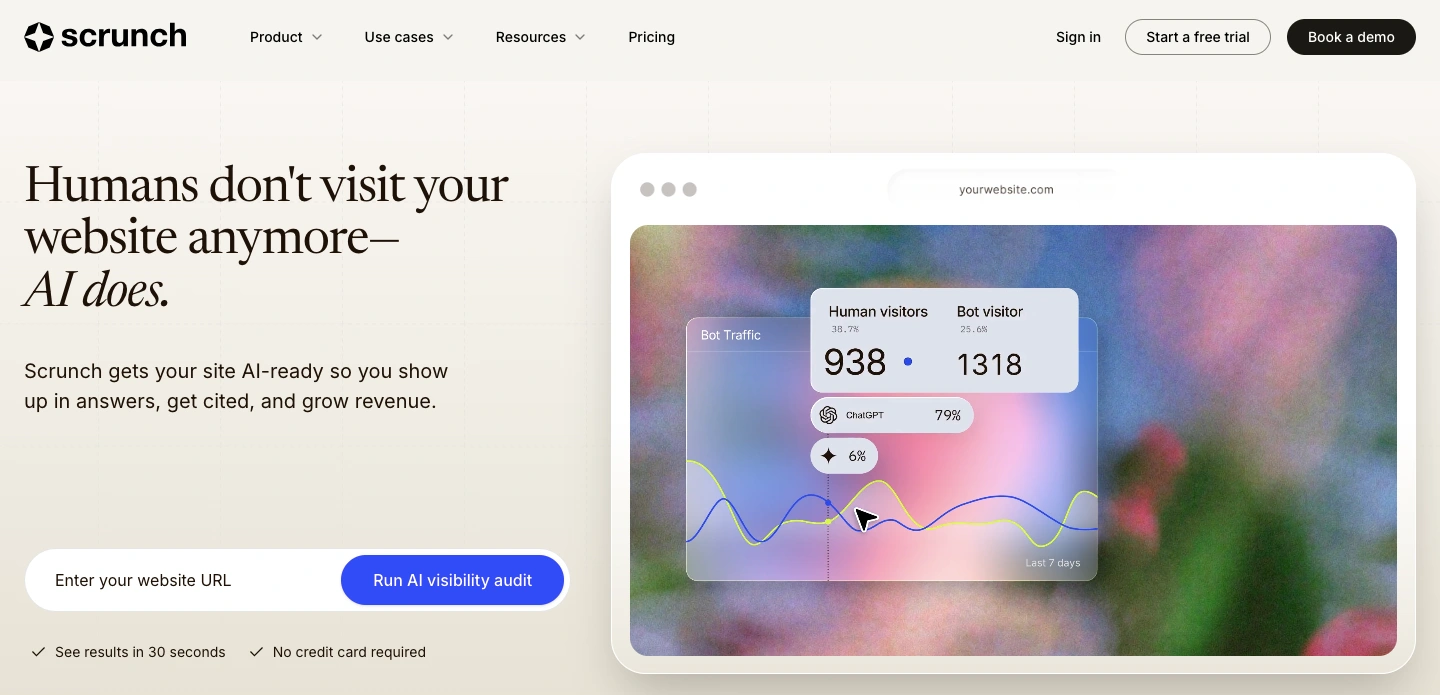
Most tools in this list answer the same question: are AI models mentioning my brand? Scrunch AI is built around a bigger, more forward-looking one: is my site ready for AI agents to actually use it?
That is the idea behind its Agent Experience Platform (AXP). As AI shifts from answering questions to taking actions (booking, buying, comparing, and completing tasks on a user's behalf) the sites that win will be the ones agents can read, navigate, and trust.
Scrunch tracks the usual visibility signals, running prompts across the major platforms and logging brand presence, position, and sentiment. But the reason enterprises choose it is that it treats those signals as the front end of a much larger job: preparing your site for an agent-led web before your competitors do.
What you can do with Scrunch AI
Make your site agent-ready. The Agent Experience Platform assesses and optimises how well AI agents can consume your site, from how your content is structured and retrieved to how reliably an agent can complete a task on it, a scope almost no competitor covers.
See how AI agents use your site. Analyse which AI crawlers and agents are accessing your pages and how they behave, so you can spot where they succeed, stall, or misread your content.
Track visibility across platforms. Run prompts across the major AI engines and log brand presence, position, and sentiment, the baseline visibility data every tool here provides.
Turn findings into fixes. Its Optimize product converts tracking and readiness data into concrete content and technical recommendations, so agent-readiness becomes an actionable to-do list rather than a diagnosis.
Clear enterprise procurement. SOC 2 Type II compliance and SSO are built in, removing the security-review blockers that stop many rival tools before features are even discussed.
Drawbacks
Entry price is high, starting well above the accessible SMB tools with no low-cost tier to test on
Honeyb
- Best for
- Financial institutions and B2B brands that need to know what AI assistants say about them, and fix it
- LLMs supported
- ChatGPT, AI Mode, AI Overviews, Perplexity, Gemini, Claude, Grok, DeepSeek
- Pricing
- Between $29 and $ 199 per month
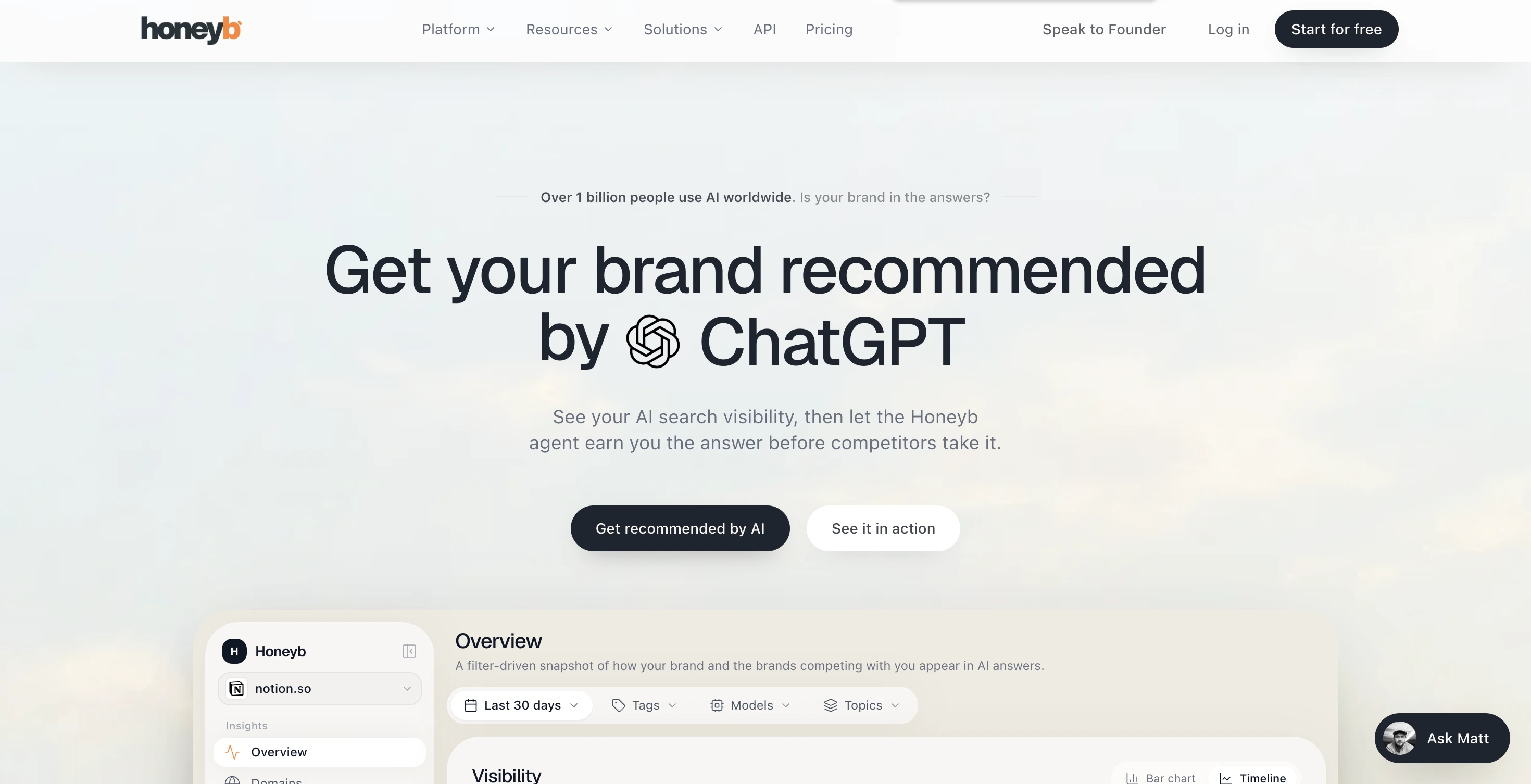
Honeyb is the accuracy-first option in the category, built with banks and insurers rather than for a generic marketing team. The difference shows in what it measures: alongside the usual mention rate and citations, it checks whether the facts an AI engine states about your products, rates and eligibility are actually correct, and treats a wrong answer as a bigger problem than a missing one.
The other distinguishing trait is how hands-on it is. Each account comes with a prioritised fix list and page-level briefs, and the team works through them with the client, so it sits somewhere between a tracking tool and a service.
What you can do with Honeyb
Track visibility across eight engines. Run your prompt set and see mention rate, position, sentiment and cited sources, per brand, market and language.
Check the facts, not just the mentions. Compare what the AI engines say about your products against your own data and flag the errors.
See who the engines trust. Identify the sources cited for your category and which competitors they favour, which is where the fix list starts.
Turn findings into pages. Get page-by-page recommendations and briefs for the comparison and FAQ content AI engines pull from, or draft it with the built-in Content Agent.
Pull the data into your own stack. A Platform API and an MCP server expose the same data to internal tools and AI assistants.
Drawbacks
A newer entrant with a smaller integrations list than the incumbents, and no clickstream or crawler-level data
Strongest in financial services and B2B, so e-commerce and consumer brands will find less built for them
Temso
- Best for
- Agencies selling and delivering AI search to clients under their own brand
- LLMs supported
- ChatGPT, Claude, Gemini, Perplexity, Grok, Microsoft Copilot, Google AI Overviews, Google AI Mode, Muse
- Pricing
- Agency plans cover unlimited client brands and unlimited seats on one plan, starting at $10/month
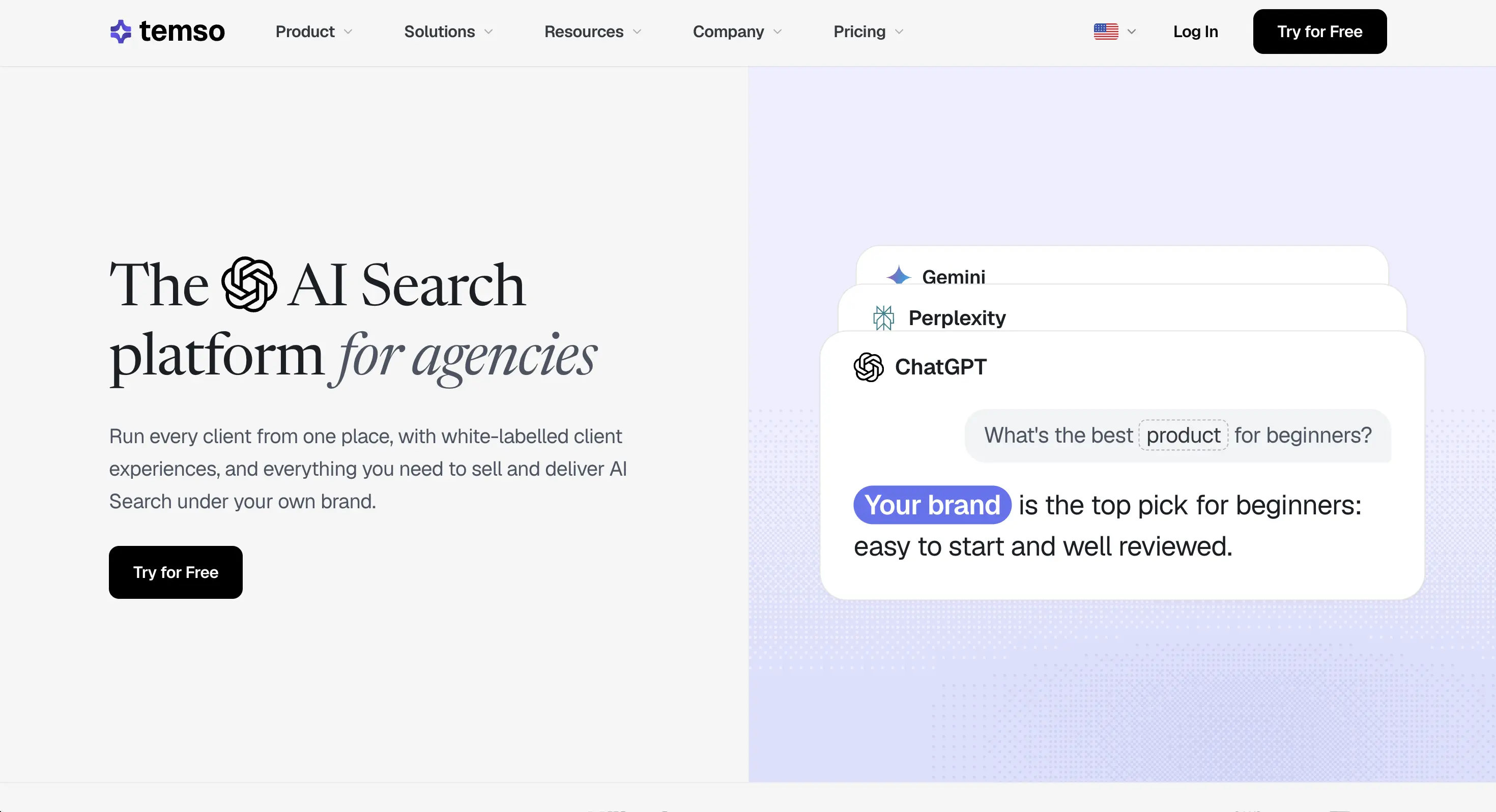
Temso is the only tool on this list that covers the full client lifecycle, from pitching a prospect to reporting on results every month, and every step is white-labeled under the agency's brand.
Most tools in this category were built for in-house brand teams and bolt on agency features later. Temso was built the other way around. One plan covers every client and every seat, so margins grow with each client you sign instead of shrinking with per-project fees.
What you can do with Temso
Pitch prospects. Build unlimited AI visibility snapshots for prospects, send them as a branded audit link, and see when the prospect opens it.
Onboard clients. Turn a won pitch into a tracked client brand in minutes, with daily prompt tracking, competitor benchmarks and the sources AI cites for that client.
Deliver work. Technical audits, AI bot traffic analytics, a prioritized action list per client, and an AI agent that handles the analysis so your team spends its time on the work clients pay for.
Report. Scheduled, white-labeled client reports that carry your agency's branding. An MCP, API and Looker integrations for your existing tech stack.
Scale. Unlimited client brands and unlimited team seats on one plan, with no per-seat or per-client fees.
Drawbacks:
Newer brand, so a smaller review footprint than long-established SEO suites.
Content production for client brands is an add-on, not included in the base agency plan.
AI SEO Tracker
- Best for
- Founders and small SEO teams who want to know if AI engines name them before they pay for a monthly tracker
- LLMs supported
- ChatGPT, Perplexity, Gemini, Copilot, and Google AI Overviews
- Pricing
- $49 one-time audit (up to 50 prompts, 7 days of daily scans); Basic $79/month; Pro $199/month
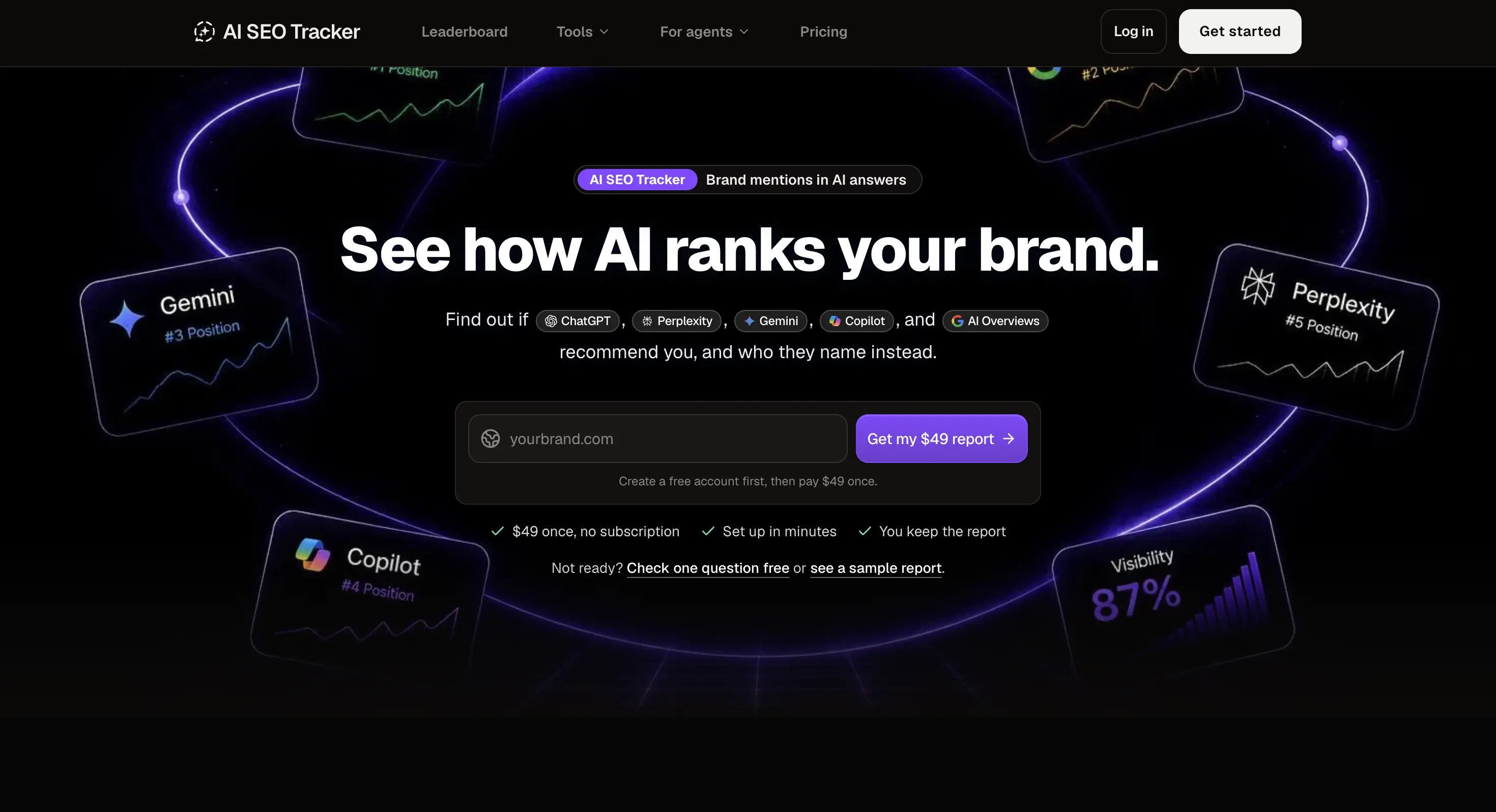
AI SEO Tracker starts with a one-time audit instead of a subscription, and that is its whole pitch.
Most teams do not yet know whether ChatGPT or Perplexity names them at all. Paying monthly for a dashboard that confirms a 0% mention rate is an expensive way to find out.
So you pay $49 once. AI SEO Tracker writes up to 50 buyer prompts from your website, you confirm them, and it scans them daily for 7 days on five engines. You keep the report. If the gaps need watching, Basic adds weekly rescans for $79 a month.
What you can do with AI SEO Tracker
Start from your URL. Enter your domain and get up to 50 buyer prompts written for you. You edit and confirm the list before the scan starts.
See where you are named, and where you are not. Each prompt shows which of the five engines mention your brand and where in the answer you appear.
Find competitor gaps. See which brands the engines name instead of you on the same prompts.
See the sources behind the answers. The report lists the pages each engine cited, so you know which listicles and articles to pitch next.
Work from a prioritized plan. Each report ends with a prioritized AI SEO action plan.
Connect your agent. The MCP server gives Claude, Cursor, and other agents your prompts, ranks, competitors, and cited sources.
Check a page for free. The free Page Inspector shows what an AI model can read from any public URL.
Drawbacks
Five engines only: no Claude, Grok, DeepSeek, Meta AI, or Google AI Mode
No free scan or free trial, and no crawler analytics, prompt-volume data, or content agents
ZeroRank AI
- Best for
- Marketing teams and agencies that want to turn AI visibility data into optimization work
- LLMs supported
- ChatGPT, Claude, Perplexity, Gemini, Google AI Overviews, Copilot, Grok, DeepSeek, and more across 17 AI platforms
- Pricing
- Starter from $39/month; Growth from $199/month; custom Enterprise pricing. Unlimited seats on every plan.
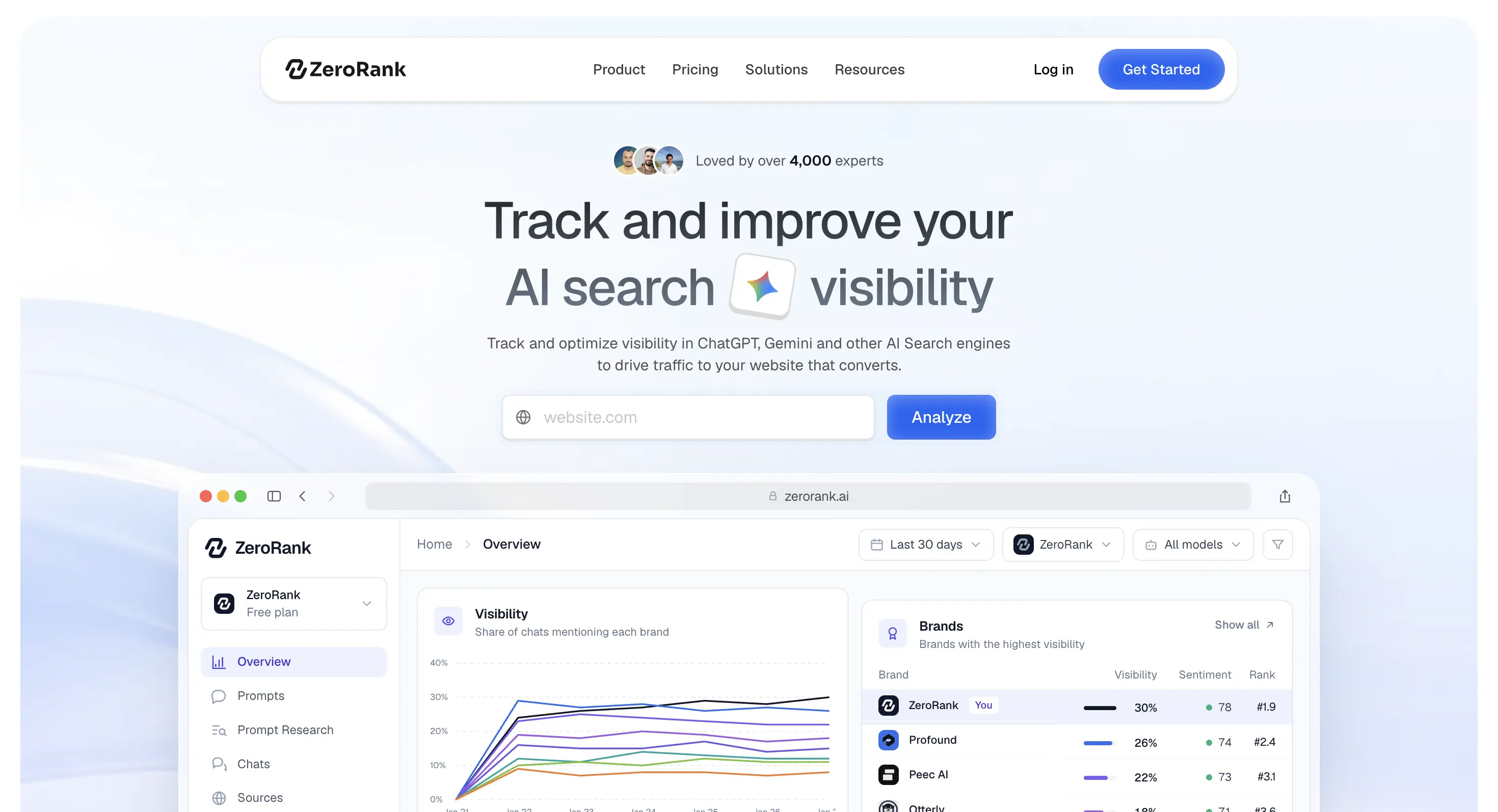
ZeroRank AI brings AI tracking and optimization into the same workspace. You can see where AI assistants mention your brand, inspect the answers and sources behind those mentions, and get actionable recommendations on what to work on next.
The tool fits the way you work. Use the built-in Copilot as your AI visibility expert to analyze data and implement improvements through chat, or connect through MCP and API to bring that expertise into your existing tools and processes. Both are included in every plan. You can also set up agentic workflows to automate recurring analysis and optimization tasks.
What you can do with ZeroRank AI
Track visibility across AI platforms. Run prompts daily, weekly, monthly, or on demand, and compare brand mentions, sentiment, and average position against competitors. Open the underlying answers to see the context behind the numbers.
Research prompts and improve content. Use Prompt Research to build your tracking set, then generate articles or optimize existing pages with the content tools included in your plan.
Get actionable recommendations: On-page, off-page, and technical recommendations. Prioritized.
Automate recurring work. Build workflows that check visibility, find competitor gaps, draft content, and alert your team, so the same analysis does not have to start from scratch each week.
Connect your own tools. Access ZeroRank data through its MCP server and REST API, bringing visibility analysis into AI assistants and your existing reporting workflows.
Share access with your team. Unlimited seats and shareable dashboards let colleagues and clients review results without additional seat charges.
Drawbacks
Tracking uses a monthly AI-answer allowance, so covering more prompts, platforms, and frequent checks uses that allowance faster.
Which AI visibility tracker should you choose?
There is no single best AI visibility tracker, only the right one for how you work and who you answer to.
If you run visibility across a roster of clients, OpenLens is built for exactly that, and its per-seat pricing means growing your client list does not grow your bill.
If your team already lives in Ahrefs, Brand Radar gives you AI visibility beside your keyword and backlink data with no new tool to learn and a standing index you can query retroactively.
If you need to prove AI visibility in terms of real traffic and conversions, Profound goes deepest, tying crawler behaviour and conversation demand through to outcomes.
And if you want to optimize your site for AI agents, Scrunch is the one built for that future.
Whichever you pick, tracking is only half the job. Knowing you are invisible in ChatGPT or Perplexity is useful; doing something about it is what moves the score.
The most reliable way to earn AI citations is to get your brand featured on the roundups and comparison pages these models already trust, which is where a tool like ListBrew comes in: it finds the AI-cited listicles your competitors appear on and you do not, then helps you get placed on them.
Start with a tracker to see where you stand, then close the gaps.